Discover practical solar panel starter kits that fit RVs, campers, boats, and off-grid cabins. This guide highlights five solid options that balance ease of setup, reliability, and value. Each kit includes panels, a charge controller, and essential accessories to help you begin generating clean energy quickly. Explore features, specs, and how these kits perform in common sun conditions to make an informed decision for your first solar project.
| Product | Brand | Highlights |
|---|---|---|
| Renogy 200W Starter Kit (2x100W) | Renogy | PWM controller, versatile for RV/boats |
| Renogy 200W Complete Starter Kit | Renogy | Includes 100Ah lithium battery and inverter |
| ECO-WORTHY 200W Starter Kit | ECO-WORTHY | Wide off-grid applications |
| Renogy 100W Starter Kit | Renogy | Compact 100W option with LCD controller |
| ECO-WORTHY 200W Complete Starter Kit | ECO-WORTHY | Includes battery and inverter |
Note: All kits are designed for off-grid use and vary in included components such as lithium batteries, inverters, and monitoring features. Consider your daily power needs, typical sun exposure, and whether you prefer PWM or MPPT control when selecting a kit.
Renogy 200W Starter Kit With 2 Panels

The Renogy 200W Starter Kit combines two 100W monocrystalline panels with a Wanderer 30A PWM charge controller. It is designed for RVs, boats, trailers, campers, and off-grid systems. Expected daily energy under typical sun is around 1000Wh with 22% cell efficiency. The system uses multi-layer encapsulation for durability and a heat-dissipating back sheet to maintain steady output. The PWM controller supports Sealed, Gel, Flooded, and Lithium batteries and offers four-stage charging for safe, efficient battery charging.
Renogy 200W Complete Starter Kit

This comprehensive kit includes two 100W panels, a 30A PWM charge controller, and a 100Ah lithium battery plus a 600W premium solar inverter. It’s well-suited for RVs, homes, cabins, and boats that need reliable solar power and a built-in energy storage solution. The kit emphasizes high-efficiency panels with 22% cell efficiency, long cycle life, and a built-in Battery Management System to prevent overcharge and short circuits. It targets users who want a ready-to-go system with scalable energy storage.
ECO-WORTHY 200W Starter Kit With 30A Controller

Eco-Worthy’s 200W Starter Kit offers a complete off-grid solution with two 100W panels, a 30A PWM controller, and a 100Ah lithium battery. It’s designed for RVs, campers, caravans, and small cabins. The system provides roughly 800Wh per day under good sun and is built with corrosion-resistant aluminum frames, IP65-rated junction boxes, and weather-tolerant design. The included battery management features aim to protect battery health and prolong system life in variable outdoor conditions.
Renogy 100W Starter Kit With LCD Controller

The 100W Renogy Starter Kit includes a high-efficiency 100W monocrystalline panel, a 30A LCD PWM charger, and a complete set of cables and mounting hardware. It delivers around 500Wh daily in optimal sunlight, with 22.5% cell efficiency and UL/CSA/IEC safety verifications. The 25-year power output warranty adds long-term reliability for off-grid camping, small cabins, or emergency backup power. The kit emphasizes durability and safety, supported by robust weather resistance ratings.
ECO-WORTHY 200W Complete Starter Kit

This complete 200W solar system bundles two 100W panels with a 30A PWM controller, a 100Ah lithium battery, and a 1100W inverter. It offers a practical, beginner-friendly setup for RV adventures or off-grid trips, with four-step installation guidance. The lithium battery supports extended life cycles, and the inverter provides ample power for most RV appliances. The kit is designed to deliver consistent daily output while simplifying assembly for newcomers to solar energy.
ECO-WORTHY 200W Starter Kit For RV, No-Fuss Assembly
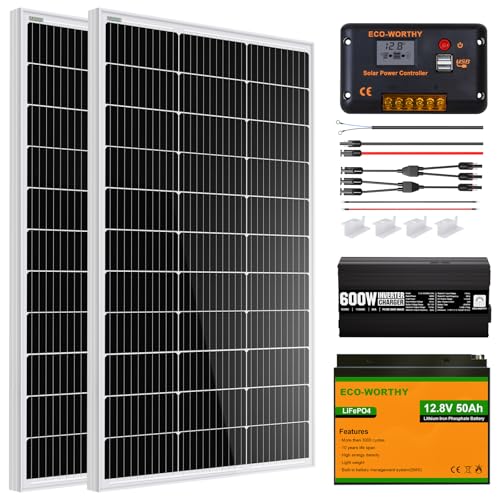
Eco-Worthy’s 200W Starter Kit for RVs emphasizes a complete, beginner-friendly setup with a 30A PWM controller and a 50Ah lithium battery plus a 600W inverter. It’s designed to be a practical entry point for RV trips and off-grid living, offering a daily output around 800Wh under suitable sunlight. The kit focuses on a durable build, user-friendly installation, and long-term battery health through proper charging management.
Buying Guide: Key Purchase Considerations
- Power needs: Calculate daily watt-hours based on devices you plan to run. A larger daily demand may justify kits with higher inverter capacity and higher Ah rating for the battery.
- Panel efficiency and quantity: Higher efficiency panels generate more power in less space, but cost may vary. Two 100W panels can be a flexible starting point for a small RV or cabin.
- Battery chemistry: Lithium-ion (LiFePO4) offers longer life and deeper discharge than lead-acid but adds cost. Consider BMS features for safety and longevity.
- Charge controller type: PWM controllers are affordable and simple but less efficient with larger arrays. MPPT controllers optimize power harvest in varying temperatures and sunlight.
- Durability and weather resistance: Look for IP-rated junction boxes, corrosion-resistant frames, and tested wind/snow load ratings to handle outdoor installations.
- Expandability: If you anticipate growing your system, choose kits that scale with additional panels or battery banks and compatible inverters.
- Installation and monitoring: Some kits include Bluetooth/Wi-Fi or LCD displays for easier monitoring. Ensure you have the right mounting hardware for your setup.
- Warranty and service: Check panel power output warranties and the duration of coverage for panels, controllers, and batteries. Longer warranties indicate more robust reliability.
- Portability vs. permanence: For frequent movement ( RV trips ), consider lighter, modular kits. For a fixed cabin, a larger, integrated system may be preferable.
- Safety standards: Look for UL, IEC, or CSA certifications to ensure safety and quality across components.
These considerations help compare kits across brands, such as Renogy and ECO-WORTHY, which offer different combinations of panels, controllers, batteries, and inverters. The right choice depends on your location’s sunlight, budget, and intended use case—whether you’re powering lights at a campsite, running appliances on a boat, or supporting a tiny off-grid home.