Discover tunable RF bandpass filters that can enhance selectivity, reduce interference, and protect sensitive receivers. This guide highlights five well-regarded options, spanning multiband filter banks, universal active filters, and high-power or crystal-based filters. Each product is evaluated on bandwidth flexibility, construction quality, and ease of integration for common radio setups. Use the buying guide at the end to compare options and pick the right filter for your needs.
Summary Table of Chosen Products
| Product | |||
|---|---|---|---|
| Nooelec Ham Filter Bank Barebones | NooElec | Five bands in one module for versatile operation | Product Page |
| Taidacent UAF42 Universal Active Filter | Taidacent | Configurable low-pass, high-pass, and band-pass with classic SV architecture | Product Page |
| Hoozilic 200W Shortwave Band Pass Filter | Hoozilic | High power handling and strong interference reduction | Product Page |
| 1PCS Bandpass Filter 10M 10MHz | GODIYMODULES | Low insertion loss with 7–11 MHz bandwidth | Product Page |
| Taidacent Quartz Crystal RF Bandpass Filter 10.7MHz | Taidacent | Precise narrowband filtering at 10.7 MHz | Product Page |
Nooelec Ham Filter Bank Barebones

Nooelec’s filter bank bundles five selectable ham radio filters into a single module, simplifying multi-band operation. The design provides high-performance passband filters for 2m (144–148 MHz), 1.25m (220–225 MHz), 70 cm (420–450 MHz), 33 cm (902–928 MHz), and 23 cm (1240–1300 MHz). This arrangement supports selective signal processing and protects transceivers from unwanted interference across multiple bands. The compact form factor makes it suitable for portable or base installations where quick band switching is beneficial.
Taidacent UAF42 Universal Active Filter

The UAF42 is a versatile active filter that can be configured for low-pass, high-pass, or band-pass filtering. It uses a traditional state-variable (SV) analog topology with an inverting amplifier and two integrators. A notable feature is an on-chip 1000 pF capacitor trimmed to 0.5%, which helps optimize filter response. This module is well-suited for experiments, educational projects, or hobbyist radio setups where customizing filter characteristics is valuable, and it supports various impedance and gain configurations to match different front-end components.
Hoozilic 200W Shortwave Band Pass Filter

This high-power bandpass filter is designed to handle up to 200W, making it suitable for demanding ham radio practices and contest work. It emphasizes strong interference reduction and clear signal transmission, with a secure M-type female connector for reliable radio integration. The filter’s construction targets robust performance in noisy environments, reducing stray signals that can degrade reception and transmission quality on voice and data modes across shortwave bands.
1PCS Bandpass Filter 10M 10MHz
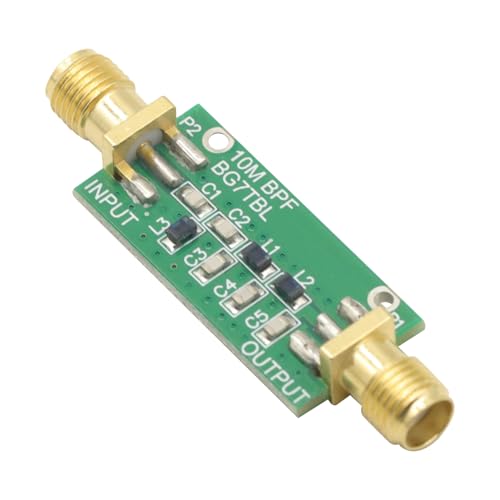
Designed for the 10-meter amateur band, this filter offers a bandwidth of roughly 7–11 MHz with low insertion loss, typically under 1.3 dB. Its straightforward design supports reliable filtering for quick installations or experiments where a compact, single-band component is sufficient. It’s suitable for hobbyists building simple filters for specific transmitter or receiver stages.
Taidacent Quartz Crystal 10.7 MHz Bandpass Filter

This narrowband quartz crystal filter targets 10.7 MHz with a tight ±7 kHz specification and compact dimensions (about 24 × 47 mm). Quartz crystal filters deliver stable center frequency and predictable passbands, which makes them ideal for precise CW or SSB reception and measurement setups where stable, narrow filtering is crucial.
Generic Premium Band Pass Filter for Enhanced Radio Reception

This general-purpose premium bandpass filter aims to improve overall radio reception by selecting desired bands while suppressing out-of-band signals. Material quality and construction contribute to durability and long-term reliability, with emphasis on stable signal transmission and good sensitivity across the included passbands. It’s a flexible option for users assembling multi-band radios or upgrading aging front-ends.
Buying Guide: Key Purchase Considerations
Choosing the right tunable RF bandpass filter depends on several practical factors. Consider the following perspectives to ensure the best fit for your radio system, environment, and goals.
- Bandwidth and center frequency: Verify the exact passband and whether the filter can accommodate your target frequencies. Multiband modules are convenient but ensure each band meets your needs.
- Power handling: For transmitter paths, confirm the maximum power rating to prevent filter damage and distortion. High-power filters reduce risk in contesting and high-SWR scenarios.
- Impedance and connectors: Match input/output impedance (commonly 50 ohms) and connector type (SMA, N-Type, etc.) to your gear. Poor matches degrade return loss and performance.
- Insertion loss and selectivity: Lower insertion loss preserves signal strength, while higher stopband attenuation improves noise rejection. Balance these with price and size.
- Configuration and adjustability: Active filters and tunable crystal-based options offer different levels of configurability. Determine whether you need fixed, adjustable, or programmable responses.
- Physical size and mounting: Consider enclosure dimensions, shielding, mounting options, and heat dissipation, especially for high-power installations.
- Ease of integration: Look for modules with clear documentation, compatible board footprints, and straightforward wiring to minimize setup time.
- Quality and stability: For critical communications, prioritize filters with low drift, stable center frequency, and robust construction against environmental factors.
- Price-to-performance: Weigh the benefits of a multiband bank against single-band precision filters. The best choice depends on whether you need broad coverage or ultra-narrow selectivity.
- Use case alignment: Recreational hobbyists may prefer modular filters for experimentation, while operators in crowded bands may demand high rejection and minimal interference.