The best tablet-controlled digital mixer depends on how many inputs you need and whether you prioritize built-in wireless control, recording connections, or detailed output processing. The Behringer XR18 is best for larger live or studio setups, while the XR16 and XR12 suit smaller rigs. The Soundcraft Ui12 stands out for its listed processing and broad device compatibility; the Behringer FLOW 8 is a compact choice with Bluetooth app control and physical faders.
| Mixer | Best For | Standout Listed Feature |
|---|---|---|
| Behringer X AIR XR18 | Larger input setups | 16 Midas-designed preamps and multichannel USB audio |
| Behringer X AIR XR16 | Medium-sized setups | 16 inputs and built-in Wi-Fi |
| Behringer X AIR XR12 | Smaller tablet-controlled rigs | Integrated tri-mode Wi-Fi router |
| Soundcraft Ui12 | Detailed channel and output processing | EQ, dynamics, and cross-platform control |
| Behringer FLOW 8 | Compact setups with physical faders | Bluetooth app control and two FX processors |
Behringer X AIR XR18
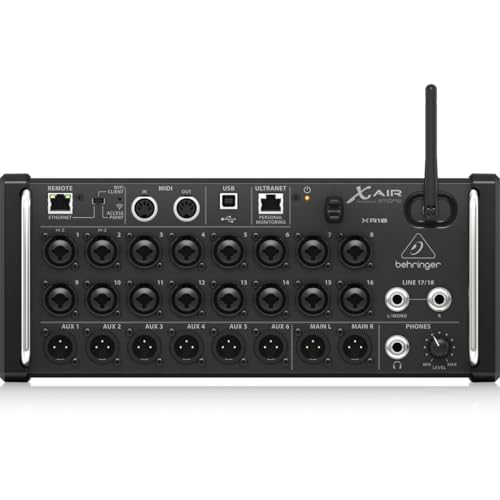
The XR18 is best for bands, venues, and recording setups that need up to 18 inputs and tablet-based control. Its listed features include 16 programmable Midas-designed mic preamps, a 12-bus design, a built-in tri-mode Wi-Fi router, and a multichannel USB audio interface.
Choose this model if your setup needs more inputs and you want multichannel USB audio alongside wireless mixer control. The built-in router allows direct operation without an external router, according to the product information. Its larger feature set may be more than necessary for a small setup with only a few sources.
Behringer X AIR XR16

The XR16 is best for users who need a 16-input mixer but do not require the XR18’s listed 18-input capacity. It is controlled by iPad or Android tablets and includes eight programmable Midas-designed mic preamps, eight line inputs, an integrated tri-mode Wi-Fi router, and a USB stereo recorder.
It is a practical middle option for live and studio applications where built-in wireless control and a stereo recording function fit the workflow. Choose the XR18 instead if you specifically need its 16 listed mic preamps or multichannel USB audio interface. The XR16 has fewer mic preamps than the XR18.
Behringer X AIR XR12
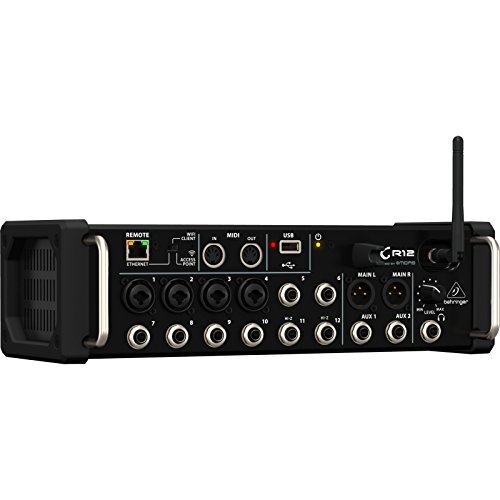
The XR12 is best for buyers seeking a smaller X AIR tablet-controlled mixer. Its listed features include an integrated Wi-Fi module, a built-in tri-mode Wi-Fi router for direct operation, and rack ears.
Choose this model if you want a straightforward rack-mountable option and do not need the higher input counts listed for the XR16 or XR18. Its product details provide fewer specifications than those of the larger X AIR models, so compare the full input and connection requirements for your setup before choosing it.
Soundcraft Ui12 Remote-Controlled Mixer

The Soundcraft Ui12 is best for users who want detailed processing controls and device flexibility. The listed input-channel tools include four-band parametric EQ, a high-pass filter, compressor, de-esser, and noise gate. Its outputs include 31-band graphic EQ, noise gate, and compressor, with a real-time frequency analyzer on inputs and outputs.
The mixer supports control from tablets, laptops, and computers running iOS, Android, Windows, Mac OS, or Linux. Choose it if output processing and broad platform support matter. Its listed 12-channel capacity may be limiting for setups that need more channels.
Behringer FLOW 8 Digital Mixer

The FLOW 8 is best for compact setups where physical faders and mobile app control are both useful. Its features include eight inputs, Bluetooth audio, FLOW App remote control from iOS or Android phones and tablets, 60 mm channel faders, a master rotary control with an LED collar, two FX processors, and a USB/audio interface.
Choose this mixer if you prefer hands-on faders alongside wireless control. The stated eight-input design makes it less suitable than the XR16 or XR18 for larger source counts. Its app-control description specifies Bluetooth remote control, rather than the built-in tri-mode Wi-Fi router listed for the X AIR mixers.
Buying Guide: How To Choose A Tablet-Controlled Digital Mixer
How many inputs does your setup need?
Start by counting microphones, instruments, playback sources, and other inputs you plan to use at the same time. The listed models range from the eight-input FLOW 8 to the 18-input XR18. Leave room for sources you expect to add, but avoid selecting a larger mixer based on channel count alone if its other features do not fit your needs.
Do you need built-in Wi-Fi or Bluetooth control?
The XR12, XR16, and XR18 list integrated Wi-Fi modules and tri-mode routers for direct operation. The FLOW 8 lists Bluetooth remote control through its app. These are different connection descriptions, so compare them with your preferred control workflow rather than assuming the connection methods are interchangeable.
What recording and processing features matter?
For multichannel USB audio, the XR18 is the clearest match among these products. The XR16 lists a USB stereo recorder, while the FLOW 8 lists a USB/audio interface. The Ui12 emphasizes channel and output processing, including EQ and dynamics tools. Match the listed recording and processing features to your actual production or live-sound needs.
Frequently Asked Questions
Can a tablet control all of these mixers?
The XR models are described as tablet-controlled, and the FLOW 8 app supports iOS and Android phones or tablets. The Ui12 lists control from tablets as well as computers.
Which mixer has the most listed inputs?
The Behringer XR18 is listed as an 18-input mixer, the highest input count among the five selected products.
Which option lists multichannel USB audio?
The Behringer XR18 product details list a multichannel USB audio interface.
Which mixer is designed for physical fader operation?
The Behringer FLOW 8 lists 60 mm channel faders and a master rotary control with an LED collar.
Which product lists the most extensive output processing?
The Soundcraft Ui12 lists 31-band graphic EQ, noise gate, and compressor on all outputs, plus a real-time frequency analyzer on inputs and outputs.