For hobbyists and professionals who print or model small items, a compact 3D scanner is essential. The following picks specialize in small-format objects, delivering high accuracy, fast scanning, and portable design. This guide highlights five top options, with quick technical notes to help you compare features such as resolution, speed, weight, and ease of use. Each entry includes a direct link to Amazon for detailed specs and current availability.
| Product | Approx. Weight | Accuracy (mm) | Supported Surfaces |
|---|---|---|---|
| 3DMakerpro Seal Lite | Lightweight | 0.02 | Mono texture; indoors |
| 3DMakerpro Moose Lite | ~250–280 g | 0.05 | Smart tracking; portable |
| Revopoint MetroY Pro | Portable | 0.01–0.02 | Multi-mode blue laser; fast |
| Revopoint MetroX | Portable | 0.01–0.02 | Blue laser; dark surfaces |
| Revopoint POP3 Plus | Handheld | 0.04 | Full-color scans; medium objects |
Seal Lite 3D Scanner by 3DMakerpro

The Seal Lite uses blue LED light with a short wavelength to achieve 0.02 mm precision for small-to-medium objects. Its compact form supports indoor use and mono texture capture, making it suitable for hobby projects and crafts. A working distance of 180–280 mm and anti-shake features help maintain steady scans, while its lightweight design supports on-the-go use.
Key advantages include high-detail texture capture and quiet operation, with minimal heat and no fan noise. The device is optimized for small-format scanning, helping users reproduce fine dents, edges, and surface textures in high fidelity.
3DMakerpro Moose Lite 3D Scanner
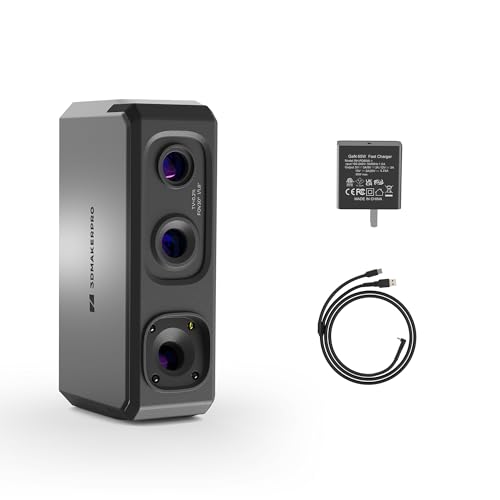
The Moose Lite is designed for light, portable use with a stated accuracy of 0.05 mm and a weight around 250 g. It emphasizes AI-assisted tracking and an efficient point cloud algorithm to streamline the creation of accurate models for printing or display. Scans are described as smooth and quiet, which makes it practical for frequent use without a noisy workstation.
With emphasis on mobility, Moose Lite aims to be a versatile companion for fieldwork or desk-based workflows. It supports 0.1 mm point resolution for detailed results and is well-suited for small-to-medium objects where precise geometry matters.
Revopoint MetroY Pro 3D Scanner

MetroY Pro is positioned as an industrial-grade handheld scanner with 0.01–0.02 mm precision and a 34+15+1 laser-based scanning system. It offers multiple modes and real-time previews, plus built-in Wi-Fi 6 for fast data transfer. This model supports full-field and auto turntable modes to accommodate diverse object shapes, making it suitable for reverse engineering and detailed metrology tasks.
Users benefit from rapid scanning speeds and the ability to capture complex geometries on small objects while maintaining accuracy across different surfaces. The device emphasizes reliability and versatility for professional workflows requiring high-detail scans.
Revopoint MetroX 3D Scanner

MetroX offers metrology-grade precision with a 0.01–0.02 mm range and a fused point cloud distance of about 0.05 mm. It provides multiple scanning modes to tackle varied geometries, including a full-field mode capable of rapid captures and an auto turntable option for automated scans. It also highlights efficient performance on dark or shiny surfaces using GPU-accelerated blue laser lines, enabling scans at up to 60 fps.
The MetroX design suits users needing high accuracy for industrial parts, tooling, and quality control, while still accommodating portable, handheld use for smaller objects and parts scanning.
Revopoint POP3 Plus 3D Scanner
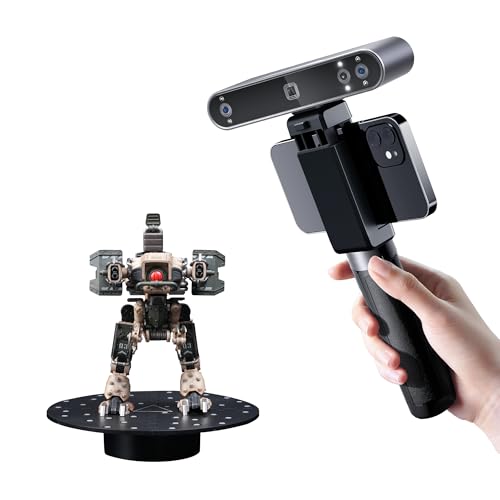
POP3 Plus emphasizes full-color scanning for medium objects with a 0.04 mm precision. It features a new calibration board, optical zoom options, and a high-speed scanning workflow with up to 18 fps. A 9-axis IMU stabilizes frames to minimize shake, delivering realistic color captures and detailed point clouds for printing or visualization on Windows, macOS, Android, and iOS.
Designed for users who want reliable color captures and fast performance on everyday objects, POP3 Plus balances accuracy with convenience across varied environments and workflows.
Buying Guide: Key Considerations for Small Object Scanners
- Accuracy vs. object size: Smaller items benefit from higher precision (0.01–0.02 mm) to capture fine details; ensure the scanner’s technical specs match your typical object scale.
- Weight and portability: For on-the-go use, prioritize lightweight models (roughly 200–300 g) with compact form factors and simple setup.
- Surface handling: Blue laser or structured light can address dark or reflective surfaces better. Consider whether you need spray-free scanning or post-processing steps.
- Scanning modes: Multiple modes (cross-lines, parallel lines, auto turntable) improve versatility for varied geometries and speeds for different projects.
- Color vs. mono textures: If color data matters for your project (such as visualization or product design), prioritize full-color capabilities; otherwise a mono texture scanner may suffice.
- Connectivity and software: Look for built-in Wi-Fi, USB, or cloud transfer options, plus compatible software for Windows and MacOS. AI tracking and point cloud processing features can simplify workflow.
- Heat and noise: Quiet operation and reliable cooling extend usability during long sessions, particularly for indoor, compact setups.
- After-sales support and ecosystem: A broader product family and reputable support help with updates, calibration, and accessories for growing needs.
When choosing, align the scanner’s strengths with your typical small-object tasks—whether you focus on archival preservation, model making, or reverse engineering. The five options above offer a mix of precision, portability, and color capture to cover common needs in hobbyist and professional work.