Robotic arms with integrated cameras enable hands-on learning in AI vision, object recognition, and autonomous manipulation. This article highlights five highly relevant options, spanning beginner to advanced setups. Each pick combines a camera or vision capability with multi-degree-of-freedom control, suitable for classrooms, hobbyists, and enthusiasts pursuing STEM projects in the United States.
| Product | Brand | Key Feature |
|---|---|---|
| Yahboom Robot Arm ROS Virtual Machine as Controller | Yahboom | VM-based control with 6DOF, AI visual recognition |
| Robotics for Kids ACEBOTT 5DOF Arm Car Kit | ACEBOTT | ESP32 controller, guided tutorials, expandable |
| LewanSoul Robotic Arm Kit 6DOF | LewanSoul | Desktop arm, software and tutorials, robust build |
| Yahboom 6DOF Robotic Arm with Depth Camera | Yahboom | 3D recognition, depth camera, large AI model support |
| HIWONDER 6DOF Robot Arm with Vision and AI | HIWONDER | Raspberry Pi 5, AI vision, OpenCV support |
Note: Each option offers different levels of software environments, camera integration, and learning curves. The selections below focus on the balance between camera-enabled vision, control, and practical learning outcomes for American readers.
Yahboom Robot Arm With VM Controller

The Yahboom VM-based robot arm uses a virtual machine as the main controller, avoiding the need for a Raspberry Pi or Nvidia Jetson. It supports complex grasping tasks, model training, garbage classification, and gesture recognition. VM software is provided for Windows, enabling precise, repeatable experiments in AI vision and robotics tasks. The arm offers 6 DOF with a robust servo system featuring metal gears and built-in potentiometers for accurate positioning. It can handle objects weighing 200–500 grams and supports multiple control methods—including a wireless controller, mobile app, and computer mouse—facilitating varied learning scenarios.
With these capabilities, users can explore AI-driven object recognition, motion planning, and basic robotic manipulation in practical projects. The mixed-control approach accommodates classroom demonstrations, at-home labs, and independent study, making this a versatile entry into vision-enabled robotics.
ACEBOTT 5DOF Robotic Arm Car Kit

The ACEBOTT kit provides a beginner-friendly path into programmable robotics. Powered by an ESP32, the 5DOF arm supports grabbing, lifting, and placing objects, with 16 guided tutorials and HD assembly videos. The kit emphasizes hands-on coding with Arduino/Python, enabling learners to explore real-world robotics concepts, control algorithms, and basic computer vision integration as add-ons. It’s a good fit for students aged 12–16 and families seeking structured STEM activities. Batteries are required but not included.
The expandable design invites ongoing exploration, with modular add-ons like cameras and robotic arms sold separately. This approach supports progressive learning—from foundational mechanics to more complex AI-enabled projects—without overwhelming beginners.
LewanSoul 6DOF Robotic Arm Kit
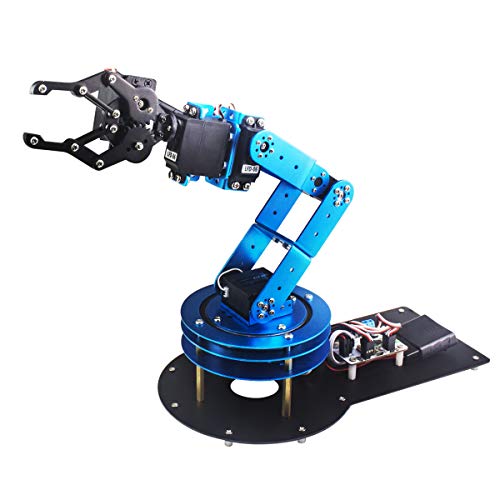
The LewanSoul LewArm 6DOF arm offers a sturdy desktop platform with six high-quality digital servos and a robust mechanical build. It supports remote control, file-based scripting, and graphical programming, making it a versatile option for creative projects and STEM learning. The design emphasizes anti-stall protection through servo gear clutches, extending component lifespan under repeated movements. A metal bracket structure and high-torque motors provide stable operation, making it suitable for demonstrations, object manipulation experiments, and introductory automation tasks.
While focused on mechanical play and education, this kit also serves as a bridge to more advanced robotics concepts, including kinematics, control loops, and simple AI-assisted tasks as users upgrade their programming skills and expand the system with additional sensors or cameras.
Yahboom 6DOF Arm With Depth Camera

This Yahboom model combines a 6DOF robotic arm with a 3D depth camera and advanced AI vision capabilities. It supports Jetson Nano, Orin Nano, and OpenRouter-based environments, enabling powerful AI vision, depth sensing, and manipulation in 3D space. The system accommodates large AI models and can recognize, track, and grasp objects using depth data and inverse kinematics. This setup is well-suited to researchers and hobbyists pursuing more sophisticated projects in autonomous grasping, AI-driven sorting, and 3D scene understanding.
The integration of depth sensing with robotic control provides a rich platform for experiments in 3D perception, object handling, and multi-model AI workflows. Users can explore complex tasks such as depth-based targeting, stacking, and autonomous pick-and-place under real-world conditions—ideal for advanced STEM enthusiasts and makers.
HIWONDER Raspberry Pi 5 Powered 6DOF Arm

The HIWONDER kit uses Raspberry Pi 5 with 8GB memory to boost AI vision capabilities alongside a 6DOF robotic arm. It emphasizes real-time AI vision recognition, target tracking, and color sorting through OpenCV-based image processing and a high-performance FPV camera. The chassis includes four high-performance encoder motors and mecanum wheels on a separate chassis, enabling first-person view operations. This combination is ideal for students and hobbyists who want to explore computer vision, AI-powered control, and mobile-style navigation within robotic systems.
As a learning platform, this option supports hands-on experiences with modern processor architectures, machine perception, and practical robot automation. It is a strong fit for education settings that want to blend vision, hardware, and software in a cohesive project.
Buying Guide: Key Purchase Considerations
- Vision and sensors: Decide whether you need a depth camera, color recognition, or basic image capture. Depth sensing enhances 3D manipulation, while color or tag tracking helps with simple object identification.
- Control method and ecosystem: Some kits rely on VM software or ESP32/Arduino ecosystems, while others use Raspberry Pi or Jetson-based platforms. Consider the learning curve, available tutorials, and software updates.
- Degrees of freedom and payload: Ensure the arm’s DOF and payload fit your intended tasks. Heavier or more precise tasks require sturdier servos, metal frames, and advanced control.
- Expandability: Look for kits that offer modular add-ons (cameras, grippers, tracks) to extend functionality as skills grow.
- Educational value: Prioritize options with guided tutorials, sample projects, and clear learning outcomes for learners at your level.
- Software support and community: Strong documentation, active forums, and documented APIs accelerate progress and debugging.
- Safety and maintenance: Check anti-stall protections, robust gear designs, and easy replacement parts to ensure long-term use.
When selecting a camera-enabled robotic arm, balance immediate learning goals with long-term growth. Beginner kits emphasizing guided projects help build confidence, while more advanced setups with depth sensing and AI vision enable deeper exploration of perception, control, and autonomous manipulation.