Selecting a reliable proximity card reader system is essential for secure and convenient access control in offices, schools, and facilities. This guide highlights five widely compatible readers that support EM4100 and ISO Prox cards, offering plug-and-play operation, multiple output formats, and durable construction. Each option is evaluated for ease of use, compatibility, and configuration capabilities to help you compare effectively and choose the right system for your needs.
| Product | Brand | Key Features |
|---|---|---|
| RFID Reader 125KHz – Reads Proximity Cards & EM4100 | FissaiD | 125KHz EM4100 + 1326/1346/1386 ISO Prox; HID USB; 40 output formats |
| BlissKiss 125KHz RFID Reader | BlissKiss | Universal driverless HID keyboard; reads EM4100 and ISO Prox; 40+ formats |
| HID ProxPro Proximity Card Reader | HID | Medium-range; Wiegand/RS-232/RS-422; indoor/outdoor sealing |
| LBS EM/ID Waterproof Wiegand Reader | LBS | 26/34bit Wiegand; EM/ID cards; panel-dependent operation |
| Ajfwm RFID Scanner Dual-Frequency Reader | Ajfwm | 125KHz/13.56MHz; EM4100 + 1326/1346/1386 ISO Prox; 40 formats |
RFID Reader 125KHz Proximity Cards & EM4100 – USB Keyboard Emulation

The FissaiD RFID Reader supports both EM4100 ID cards and ISO Prox formats, including 1326 family cards. It can emulate a USB HID device, enabling immediate integration with Linux, Android, Windows, and iOS systems without extra drivers. The reader provides up to 40 data formats for the EM4100 UID and allows user configuration via a simple config card. This makes it suitable for multi-card environments and legacy systems that rely on 125KHz proximity technology.
BlissKiss 125KHz RFID Reader – USB Proximity Card Scanner

BlissKiss offers universal driverless operation by acting as a standard HID USB keyboard. It reads both 125KHz EM4100 IDs and ISO Prox cards (1326/1346/1386, including H10301/H10304). With over 40 configurable output formats, administrators can tailor UID output (10H or 13-digit), apply prefixes/suffixes, ignore leading zeros, or output raw Wiegand data. This flexibility makes it a strong all-around choice for mixed card environments and cross-platform deployments.
HID ProxPro Proximity Card Reader

HID’s ProxPro reader targets medium-range applications with multiple interface options, including Wiegand, serial (RS-232/RS-422), and clock-and-data. It’s designed for indoor or outdoor use and integrates into a broad range of access control systems. This reader is well-suited for installations where a solid, well-supported brand and diverse wiring options simplify integration with existing controllers and panels.
LBS EM/ID Waterproof Wiegand Card Reader

The waterproof LBS reader emphasizes resilience with EM/ID card support and Wiegand output. It is designed to operate with access control panels rather than as a standalone reader, making it ideal for installations where the reader is a component of a larger system. Compatibility with standard 26/34-bit Wiegand formats supports a broad range of controllers and configurations in challenging environments.
Ajfwm Dual-Frequency RFID Scanner – 125KHz/13.56MHz

Ajfwm provides a dual-frequency reader that covers 125KHz and 13.56MHz, supporting EM4100 and 1326 family ISO Prox cards, plus 14443A/B protocols. It features HID USB with no driver requirement and offers about 40 output formats for EM4100 UIDs. This makes it versatile for facilities migrating between legacy 125KHz systems and newer ISO Prox deployments while preserving a single device footprint.
Tqsbeyah Multi-Frequency RFID Writer and Reader
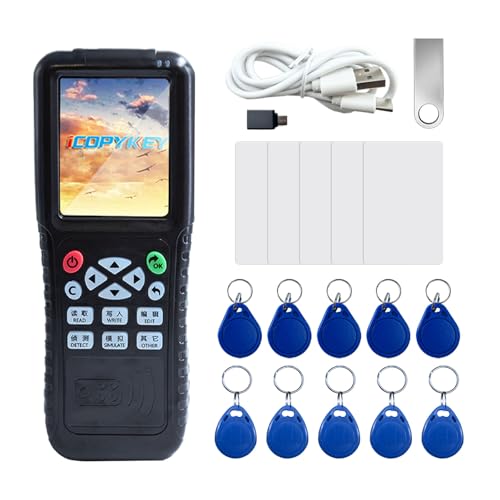
This device combines reading and writing capabilities across multiple frequencies, including 125KHz and 13.56MHz. It supports a wide range of cards (S50, S70, TK4100, EM4100, EM4200, T5577, HID, AWID, and more). It includes app-based controls for decoding and data output, though users should note Windows-only compatibility for some features. It is suited for tasks such as cloning and cloning verification in controlled environments while providing flexible data handling options.
MktStleat Proximity Cards – 100 Pack

These ISOProx-compatible clamshell cards are designed to work with 26-bit Wiegand readers that support 1386 ISOProx and 1326 formats. They are suitable for commercial access systems that rely on shared card inventories across multiple readers and controllers. The 26-bit H10301 standard aligns with many existing security deployments, simplifying mass enrollment and card issuance processes.
BSTUOKEY No-Relay Proximity Card Reader

This reading-only unit is intended to pair with an access control panel or master controller. It supports EM-ID cards and offers 2-5 cm reading distance. It’s designed for integration into larger security setups where the reader itself does not manage user data or access decisions, emphasizing reliability and compatibility within a broader system architecture.
Buying Guide — Key Purchase Considerations
- Card compatibility: Confirm EM4100, 1326/1346/1386 ISO Prox, and 26/34-bit Wiegand support align with your access control panel.
- Interface options: Decide between USB HID, Wiegand, RS-232/RS-422, or mixed interfaces based on controller compatibility.
- Power and environment: Check IP ratings and indoor/outdoor suitability for your installation site.
- Driver and platform support: Ensure driverless operation or available drivers for Windows, macOS, Linux, iOS, and Android as needed.
- Data formats and customization: Look for devices offering configurable output formats, prefixes/suffixes, and raw data options to fit your system’s data flow.
- Single-device vs. ecosystem: Some readers are standalone, while others require a panel or controller. Plan for total system integration rather than a single component.
- Reliability and brand support: Favor models with established documentation, firmware updates, and customer support to minimize downtime.
- Security considerations: Evaluate how UID formats and output routing influence audit trails and access control policies.