The Purewell Portable Electric RO Water Filter System is the closest match for off-grid use because its listing describes a rechargeable battery, USB-C charging, and portable design. The other options are mainly under-sink or aquarium systems, so they are not established as off-grid drinking-water solutions by the supplied product details. Compare power needs, source-water requirements, and intended use before choosing.
| Product | Best suited for | Off-grid fit |
|---|---|---|
| Purewell Portable Electric RO | Camping and backup water | Portable, rechargeable operation listed |
| Waterdrop G3P600 | High-volume household filtration | Off-grid operation not established |
| Waterdrop X16 | Buyers exploring high-capacity RO | Details provided are limited |
| iSpring RO1200 | Buyers exploring dual-flow RO | Details provided are limited |
| Aquatic Life RO Buddie | Aquariums and non-drinking uses | Not presented as a drinking-water system |
Purewell Portable Electric RO System

Best for: Campers, RV travelers, and households seeking a portable water option for emergencies. This is the clearest off-grid candidate in the list because the product description specifies a battery-powered system with up to 6.5 hours of use and USB-C reverse charging.
Purewell lists a 0.0001-micron RO membrane, dual UV lamps, and TDS monitoring. The description says the system can fill a 2.1-liter bottle in three minutes and identifies replaceable pre-filter and RO elements. These details make it more relevant to mobile water use than the fixed, under-sink options below.
Limitation: It is still an electric system, so its runtime is finite and depends on charging. The listing says filter life varies with water quality; confirm the source-water instructions and replacement availability before relying on it for extended trips.
Waterdrop G3P600 Tankless RO System

Best for: A household that wants a high-capacity under-sink RO system and has the installation conditions it requires. Its listed capacity is 600 gallons per day, and the system has an eight-stage filtration description, a smart display faucet, a TDS monitor, and a filter-life tracker.
The listing states that the G3P600 is certified to NSF/ANSI 58 for TDS reduction, NSF/ANSI 372 for lead-free materials, and NSF 42 for chlorine, taste, and odor reduction. It also lists third-party-tested reductions for several substances, including PFAS, fluoride, arsenic, and particles.
Limitation: The supplied details do not establish battery or solar operation, making this a weaker choice for a site without dependable power. It is a household system rather than a portable unit.
Waterdrop X16 Alkaline Mineral RO System

Best for: Buyers comparing a high-capacity alkaline-mineral RO system for a household installation. The product name identifies a 1,600-GPD rating and a black faucet, but the supplied listing information contains no feature details beyond the name.
It is included as a comparison option, not as a verified off-grid recommendation. The available information does not specify its power source, battery operation, filtration claims, installation requirements, or replacement filters.
Limitation: There is not enough supplied product information to determine whether it can work independently of grid power. Confirm its technical specifications before considering it for a remote property.
iSpring RO1200 Dual-Flow RO Filter

Best for: Buyers researching a system described as dual-flow with a 1,200-GPD high-flow rating. Those details come from the product name; no additional features were supplied for comparison.
This product is a possible household RO candidate, but its fit for off-grid use cannot be established from the available description. Check whether it needs electricity, what plumbing it requires, and whether it is designed for the source water at your location.
Limitation: No supplied information confirms its filtration stages, power setup, or off-grid capability. Do not assume it will run on battery or solar power without verifying the manufacturer’s specifications.
Aquatic Life RO Buddie 4-Stage System
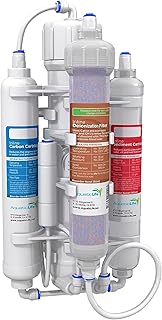
Best for: Aquarium owners and people filtering water for fountains or humidifiers, not buyers seeking a drinking-water system. The 50-GPD unit uses sediment, carbon, RO, and deionization stages according to its name and description.
The sediment stage catches debris such as sand and silt, while the carbon block helps reduce chlorine and odors. These features are aimed at aquarium and similar uses. The listing explicitly notes that its carbon filter does not remove chloramines.
Limitation: This product is presented for aquarium water, not as a potable-water purifier. Do not select it as an off-grid drinking-water system based on the supplied information.
Buying Guide: Choosing an Off-Grid RO System
Does the system work without grid power?
Confirm whether the unit has a built-in battery, supports an external battery, or needs household power. For solar setups, check the required input and power draw rather than assuming a solar panel can run it directly. Among these options, only Purewell’s description specifies battery use and USB-C charging.
How much water do you need?
Estimate daily drinking and cooking needs, then compare them with the stated output rate. GPD ratings describe capacity, but do not by themselves confirm off-grid operation. A portable bottle-filling unit may suit a trip better than a high-capacity under-sink model.
What source water will you treat?
Check the manufacturer’s approved feed-water types and limits. RO performance and filter life can vary with source-water quality. Do not assume a household RO unit is suitable for untreated surface water, seawater, or every well-water condition.
Can you maintain it remotely?
Review replacement-filter availability, expected service intervals, storage needs, and whether the system monitors filter condition or TDS. Plan for spent filters and any wastewater the system produces. Product descriptions should clearly explain installation and maintenance before purchase.
Frequently Asked Questions
Which listed system is most suited to off-grid use?
Purewell is the closest match because its listing specifies battery operation and USB-C charging. Verify its charging and source-water requirements for your planned use.
Can an under-sink RO system run on solar power?
Possibly, but these listings do not confirm solar compatibility for the under-sink models. Check power requirements and use an appropriately rated power setup.
Is the Aquatic Life RO Buddie for drinking water?
The supplied description positions it for aquariums, fountains, and similar uses, not potable water. Choose a system specifically documented for drinking-water treatment.
Does a low TDS reading prove water is safe?
No. TDS monitoring measures dissolved solids and does not identify every contaminant. Follow the product’s claims and instructions, and test source water when needed.
Should I choose the highest GPD rating?
Not automatically. Match output to household demand, but also consider power needs, source-water conditions, installation, and filter maintenance.