For radio enthusiasts seeking broader reception without constant retuning, multiband delta loop antennas offer compact, efficient performance across wide frequency ranges. This guide highlights five top options, detailing features, applications, and practical considerations to help you pick a model that fits indoor or outdoor setups while maximizing signal clarity.
The following table summarizes the selected products, including key frequency coverage and notable attributes to aid quick comparison.
| Product | Brand | Frequency Range | Key Strengths | Notes |
|---|---|---|---|---|
| GA800 Active Loop Antenna | DmgicPro | 10 kHz – 159 MHz | Low noise, tuning-free, built-in amplification | Portable; suitable for indoor/outdoor use |
| WV-601 Portable Shortwave Radio Loop | GOOZEEZOO | 10 kHz – 999 MHz | Water-resistant, passive, versatile adapters | Good for HAM and local comms |
| K-180WLA Active Loop Broadband | DmgicPro | 100 kHz – 180 MHz | Integrated protection, 20 dBi gain, long outdoor life | Battery powered; no external supply |
| MLA-30 Loop Antenna | HAON | 100 kHz – 30 MHz | Excellent directivity, compact, balcony/rooftop install | Great for reducing noise in weak-signal regions |
| Bingfu VHF/UHF Dual Band Loop | BINGFU | 136–174 MHz and 400–470 MHz | Dual-band, easy install, solid VSWR | Best for VHF/UHF handhelds and local comms |
GA800 Active Loop Antenna 10KHz-159MHz

The GA800 offers a broad frequency span from 10 kHz to 159 MHz, covering LW, MW, SW, FM, aviation bands, and U/V bands used by walkie-talkies. A notable feature is its tuning-free operation via an independent switch, allowing immediate power-on use. An integrated signal amplification and noise suppression circuit enhances weak signals and reduces environmental noise by up to roughly 20% compared with previous models. This makes it suitable for SWL and HAM listening in varied environments. For high-frequency reception (FM and aviation bands), turning off the power is recommended to minimize saturation and preserve signal fidelity.
Key considerations: ease of use, portability, and the balance between amplification and noise reduction. The GA800 aims to minimize setup complexity while delivering noticeable improvements in signal strength. It pairs well with portable radios for field use or desk setups for at-home listening sessions.
WV-601 Portable Shortwave Radio Loop Antenna

This passive, wind-resistant loop is designed for long-term outdoor use and does not require external power, making it convenient for HAM setups and field listening. It supports wide-band reception, with the 2025 version enabling UV-band transmissions up to 10 watts, enabling not only reception but local communication and relay operations. Frequency coverage spans FM, LW, MW, SW, AIR, and U/V bands, with a 50-ohm impedance and RG50-3 feeder. Gains peak around 8 dB, helping to improve reception in challenging environments while keeping power needs minimal.
Considerations include durability in outdoor conditions, compatibility with various adapters, and whether passive reception meets your noise floor requirements. For users prioritizing no-power operation and straightforward installation, the WV-601 offers a compelling balance of versatility and simplicity.
K-180WLA Active Loop Broadband Antenna

The K-180WLA is an active loop broadband antenna with a compact form factor designed for 0.1–180 MHz operation and an integrated preamplifier powered by a built-in 3.7V lithium battery. It features a complete protection circuit against reverse polarity, over-discharge, overcharge, overcurrent, and terminal short circuits, enhancing reliability for outdoor use. The design uses high-quality materials, including 304 stainless screws and a waterproof preamplifier box, ensuring durability in adverse weather. The antenna provides a gain around 20 dB within the lower bands, maintaining usable performance at higher frequencies with approximately 8.9 dB gain near 450 MHz. The device supports USB charging, compatible with standard 5V power sources.
Operational notes include battery life, gain flatness across the wide range, and the advantages of a low-noise preamplifier. The K-180WLA is well-suited for portable field operations where external power is limited, while still delivering robust performance for HAM and SW listening tasks.
SaferCCTV AN-200 Indoor Loop Antenna

This indoor loop antenna covers 520–1710 kHz, focusing on AM/MW reception with an accessible ferrite-based interior. It is lightweight and straightforward to set up, with a design that helps filter out noise and interference. Compatibility with popular receivers such as Kaito 1103, Shack DX-399, Grundig G8, and Sangean ATS-818 expands its usability for AM listening and DXing. The AN-200 offers a simple path to improved AM reception without requiring outdoor installation, making it a practical choice for den or apartment setups where space is constrained.
MLA-30 Loop Antenna Active Receiving Antenna
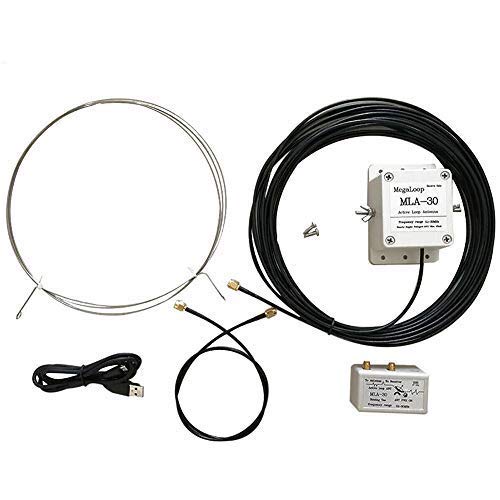
The MLA-30 from HAON emphasizes directivity to boost signal-to-noise ratio, making it effective for weak-signal reception. Its compact footprint supports easy installation on balconies or rooftops, enabling better line-of-sight to distant transmitters. The design helps reduce surrounding noise, which is crucial when multiple devices or urban interference is present. The MLA-30 is a suitable option for listeners seeking a balance between performance and space efficiency in urban or suburban environments.
Bingfu VHF/UHF Dual Band Loop Antenna

This dual-band loop supports 136–174 MHz and 400–470 MHz, delivering reliable reception for VHF/UHF handheld radios. With a gain of about 1.8–2.8 dBi and a VSWR below 1.5, it offers improved signal quality and reduced interference compared to lower-gain options. Its lightweight construction and simple installation make it a practical choice for quick setups and on-the-go operations, particularly for users focusing on local communications and portable radios.
Buying Guide: Key Purchase Considerations
- Frequency Coverage: Choose a model that spans your primary bands (LW/MW/SW, FM, AM, VHF/UHF) to reduce the need for multiple antennas.
- Power and Noise: Active loops provide amplification but can introduce noise; balance amplification with receiver sensitivity and local interference.
- Installation Environment: Indoor antennas suit apartments or desks, while outdoor antennas require weatherproofing and mounting considerations.
- Power Source: Battery-powered active loops offer portability; ensure charging options and battery life align with usage patterns.
- Directivity and Gain: Higher gain improves distant signals but may narrow the effective nulls; consider if you need wide-field reception or targeted directionality.
- Durability: For outdoor use, look for waterproof housings, corrosion-resistant screws, and robust feeders to withstand weather.
- Impedance and Connectors: Most loop antennas use 50-ohm feeders; ensure compatibility with your radio’s input and any adapters you use.
- Size and Mounting: Compact designs are advantageous for apartments; larger loops may offer better gain but require more space and secure mounting.
- Maintenance: Passive models require less maintenance, while active models may need battery or power management.
- Price-to-Performance: Compare features such as amplification, shielding, and gain against cost to determine value for your listening goals.
In practice, the best choice depends on your listening goals, installation constraints, and whether you prefer a tuning-free, powered, or passive solution. For frequent field use and broad frequency coverage, active loops like the GA800 or K-180WLA offer strong versatility. For top-of-the-line quiet reception in fixed locations, the MLA-30’s directivity can provide meaningful improvements. If you focus on AM and local communications, indoor options such as the SaferCCTV AN-200 provide simple, space-efficient enhancements.