The best choice depends on what “expensive” means for your needs: nationwide connectivity, rugged construction, or a practical rechargeable radio set. The Poclink POC-2 Titan is the most feature-rich option here for teams needing LTE-based communication, while the Retevis RB48 is suited to harsh environments. For everyday use, the pxton two- and four-radio kits and MaxTalker MT10 offer simpler rechargeable options. The listings do not include prices, so compare capabilities rather than assuming a specific price ranking.
| Product | Best For | Standout Feature |
|---|---|---|
| Poclink POC-2 Titan | Teams needing broad-area contact | 4G LTE push-to-talk |
| Retevis RB48 | Harsh work conditions | IP67 protection and drop resistance |
| pxton 4-Pack | Groups needing four radios | 16 channels and included earpieces |
| MaxTalker MT10 2-Pack | Outdoor recreation | Rechargeable battery and 22 FRS channels |
| pxton 2-Pack | Basic two-person communication | Channel and privacy-code options |
Poclink POC-2 Titan LTE Radio
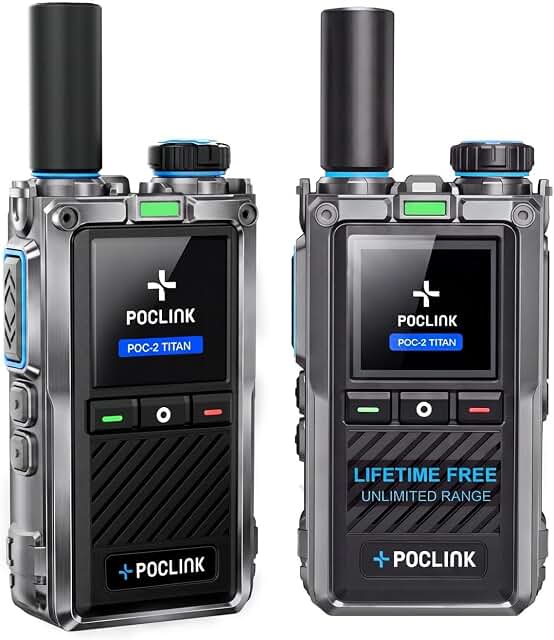
Best for: Work teams, logistics operations, and families that need communication beyond the usual local range of handheld radios. This model uses 4G LTE and push-to-talk rather than relying only on direct radio-to-radio transmission.
Listed features include a metal housing, shockproof, dustproof, and waterproof construction, a 3,000mAh rechargeable battery, Type-C charging, and support for up to 100 groups with up to 1,000 members in each. The listing describes a SIM card with no annual charge and coverage in more than 80 countries; a separate premium plan is described for up to 160 countries.
Why it was selected: It is the clearest fit for buyers seeking broad-area team communication and group management. Limitation: LTE-based communication depends on cellular service being available where it is used; it is not the same as a standalone FRS radio.
Retevis RB48 Rugged FRS Radio

Best for: Buyers who need a radio designed for demanding outdoor or jobsite conditions. The RB48 is described as tested to MIL-STD-810H and rated IP67 for water and dust protection.
Retevis also lists resistance to drops, vibration, heat, and cold. Its product information says it passed 1,000 drops from two meters and provides communication coverage of up to 300,000 square feet or 25 floors. These figures are listing claims, not a guarantee of performance in every building or terrain.
Why it was selected: Its stated protective features distinguish it from basic rechargeable two-way radio kits. Limitation: The supplied information does not specify battery capacity, included accessories, or charging details, so check the listing for those requirements before buying.
pxton 4-Pack With Earpieces

Best for: Groups that need four handheld radios for coordinating locally. The kit is listed with 16 preset channels, 165 privacy codes, earpieces, rechargeable lithium-ion batteries, chargers, and a flashlight.
Additional listed functions include VOX voice control, scanning, and a low-battery alarm. The product description estimates eight to 96 hours of use under normal circumstances and eight to 12 hours of continuous use, depending on frequency of use. It says a depleted battery takes three to four hours to charge.
Why it was selected: It provides a four-radio setup and several communication features without requiring buyers to assemble a group of separate units. Limitation: The listing notes that obstructions can reduce range, particularly in towns and cities.
MaxTalker MT10 Rechargeable FRS Pair

Best for: Campers, hikers, and families who want a two-radio rechargeable FRS set. The MT10 has a listed 1,200mAh lithium battery, 22 channels, and 99 sets of CTCSS privacy codes. Its stated standby time is up to 72 hours.
The listing claims a range of up to five miles in open areas and says the radios can communicate with other brands using the same channel and privacy code. That makes it a useful option for buyers coordinating a group with compatible channel settings.
Why it was selected: It combines rechargeable power with more channel choices than the pxton models listed here. Limitation: The five-mile figure is for open areas; buildings and terrain can affect actual communication range.
pxton Rechargeable Two-Radio Set

Best for: Two users who want rechargeable radios with earpieces and a range of channel-setting options. The package is listed with two radios, battery packs, chargers, belt clips, hand straps, earpieces, and a user manual.
Each radio has 16 preset channels, and the product description lists 50 CTCSS and 105 CDCSS codes per programmed channel. Functions include VOX voice control, scanning, a low-battery alarm, and a flashlight. The listing also describes lifetime customer service.
Why it was selected: It offers more specified privacy-code settings than the four-pack listing and includes accessories for two users. Limitation: Like other direct-radio models in this group, its practical range varies with obstructions.
Buying Guide: How to Choose a Walkie-Talkie
Do you need local radio or broad-area communication?
Choose an FRS handheld set such as the MaxTalker or Retevis for local, direct radio communication. For communication across larger areas, the Poclink uses LTE connectivity. Its coverage depends on cellular service, while conventional handheld range is affected by terrain, buildings, and other obstructions.
How many radios should the package include?
Match the package size to the number of people who need radios. The pxton four-pack is suited to larger groups, while the pxton and MaxTalker two-packs serve two users. Compare included accessories as well as radio count: both pxton sets list earpieces, while the four-pack is specifically described as including rechargeable batteries and chargers.
Which features matter for your environment?
For wet, dusty, or rough conditions, the Retevis listing provides the most explicit protection details. For hands-free voice activation, compare models listing VOX. For an outdoor group, channel and privacy-code settings can help users coordinate compatible radios, but they do not make a radio channel private or extend its physical range.
What should you check before ordering?
Review the current listing for package contents, charging equipment, battery details, and operating requirements. Confirm whether the product uses cellular service or local radio transmission, and plan around the limits of the environment where it will be used.
Frequently Asked Questions
Are the most expensive walkie-talkies always the best?
No. The right choice depends on coverage needs, durability, group size, and required accessories. The product data provided here does not include prices, so it cannot establish which model costs the most.
Which option is designed for the toughest conditions?
The Retevis RB48 is the most explicitly described for harsh conditions, with an IP67 rating and listed drop, dust, vibration, heat, and cold resistance.
Which radio is best for communication beyond local range?
The Poclink POC-2 Titan uses 4G LTE for broad-area push-to-talk communication. Its service depends on cellular connectivity.
Do privacy codes guarantee private conversations?
No. Privacy codes help users filter or coordinate channel traffic, but they should not be treated as encryption or a guarantee that others cannot hear a transmission.
Can these radios reach their advertised maximum range everywhere?
No. Range claims describe particular conditions. Buildings, terrain, and other obstructions can reduce the distance at which handheld radios communicate.