Discover compact, beginner-friendly, and feature-rich mini 3D printers that fit on desks, in dorm rooms, or small workshops. This guide highlights five top options that balance price, performance, and ease of use for American makers, students, and hobbyists.
Summary of selected products:
| Product | Brand | Key Feature | Link |
|---|---|---|---|
| Bambu Lab A1 Mini 3D Printer | BAMBULAB | Multi-color printing, auto calibration, high speed | Amazon |
| Bambu Lab A1 Mini Combo | BAMBULAB | AMS lite multi-color option, auto calibration | Amazon |
| Fully Assembled Mini 3D Printer For Kids (Asani) | Asani | Complete starter kit, auto leveling | Amazon |
| Upgraded Tina2S 3D Printer (HEPHI3D) | HEPHI3D | WiFi cloud printing, open source, quiet | Amazon |
| TINA2 Mini 3D Printer (HEPHI3D) | HEPHI3D | Fully assembled, auto leveling, resume print | Amazon |
Bambu Lab A1 Mini 3D Printer

The Bambu Lab A1 Mini provides high-speed precision with an acceleration of 10,000 mm/s², delivering fast prints with exceptional detail. It supports multi-color printing via AMS lite, enabling vibrant, multi-material creations. Full-auto calibration removes manual bed leveling, offset, and Z-offset hassles, promoting reliable starts and consistent results. Quiet operation keeps makerspaces calm, while compact dimensions fit home desks and classrooms. Notes indicate AMS lite is required for true multi-color capability, with options to upgrade to the Combo for more features.
Bambu Lab A1 Mini Combo

This combo version extends capabilities with AMS lite for multi-color printing and the same high-speed precision as the standard A1 Mini. Auto calibration streamlines setup and ongoing maintenance, while the device’s robust motion system and precise bed leveling support complex designs. Quiet operation remains a hallmark, making it suitable for shared spaces. Like the single-printer model, ensure AMS lite compatibility to unlock full color potential.
Fully Assembled Mini 3D Printer For Kids And Beginners

This ready-to-use kit is designed for young makers and first-time buyers. It comes fully assembled with a 8.3″ x 8.3″ x 11.4″ footprint, a 2.4″ LCD, a flexible magnetic build plate, and auto-leveling for one-touch setup. The kit includes 10 meters of PLA, a microSD with starter models, and accessories to support immediate printing. The emphasis is on reliability and classroom suitability, with straightforward operation and compact form.
Upgraded Tina2S 3D Printer (HEPHI3D)

The Tina2S offers smart app wireless printing via Poloprint Cloud, a large model library, and one-click slicing for cloud-based workflows. It is fully open-source and compatible with Cura, PrusaSlicer, and other slicing tools, enabling customization and DIY model uploads. The printer emphasizes a quiet operation (40–50 dB) and a print speed up to 200 mm/s, suited for home, school, and office settings. An emphasis on community-driven software complements its hardware.
TINA2 Mini 3D Printer (HEPHI3D)
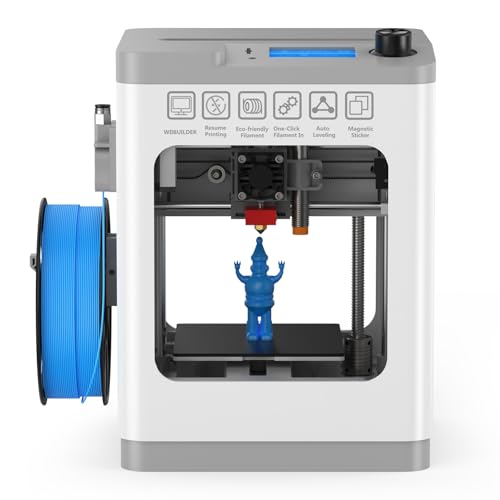
The Tina2 Mini provides a compact, beginner-friendly experience with full assembly included and auto leveling for simple setup. It supports resume printing after power interruptions and includes a removable flexible magnetic build plate for easy model removal. The device targets entry-level users, families, and classrooms seeking a balance of affordability and capable performance in a tiny footprint.
Buying Guide: Mini 3D Printer Considerations
Key factors to evaluate when choosing a mini 3D printer include print volume, print quality, speed, and reliability. Look for an auto-leveling bed to reduce setup time, and consider models with resume printing to prevent data loss from outages. Multi-color capabilities can expand project possibilities, but may require optional modules or accessories. Quiet operation is important for shared spaces, while open-source firmware and software compatibility provide flexibility for customization and future upgrades.
Other buying considerations include:
- Ease of use: beginner-friendly interfaces and guided setup help new users achieve reliable prints quickly.
- Safety features: enclosure options, filament sensors, and power-off protection improve classroom and family safety.
- Connectivity: WiFi and cloud apps simplify file transfer and monitoring, especially in group settings.
- Materials and reliability: compatible filament types (PLA, PETG, etc.), bed adhesion methods, and component durability affect long-term satisfaction.
- Upgrade paths: modular components, such as multi-color modules or expanded memory, can extend the device’s usefulness as skills grow.
In summary, the best mini 3D printer choice depends on whether you prioritize color versatility, automated calibration, educational features, or compact portability. The options listed strike a balance across these considerations for general home, classroom, and hobby use in the United States.