The best long range portable radio depends on whether you need two-way communication or long-distance broadcast reception. The Baofeng AR-5RM 2-pack is best for licensed amateur-radio users who want rechargeable handhelds and frequency-copying features. The C. Crane CCRadio 3 is better for listening to distant AM and FM stations, while the SAMCOM FPCN30A and pxton 4-pack suit team communication. The Baofeng UV-5RM offers similar programmable ham-radio features in a handheld format.
| Radio | Best For | Key Feature |
|---|---|---|
| Baofeng AR-5RM 2-Pack | Amateur-radio users | USB-C charging and frequency copy |
| Baofeng UV-5RM | Programmable handheld use | 999 memory channels |
| C. Crane CCRadio 3 | Long-range broadcast listening | Twin-coil AM antenna |
| SAMCOM FPCN30A 2-Pack | Work crews | Group calling |
| pxton 4-Pack | Small groups and outings | Four radios with earpieces |
Baofeng AR-5RM 2-Pack

Best for: Amateur-radio users who want two programmable handhelds for outdoor or emergency-preparedness communication. Each radio includes a 2500mAh rechargeable battery, USB-C cable, and charging base, so users have several ways to recharge.
The listed features include a color display, up to 999 storage channels, frequency copying, and CHIRP support. Its broad receiving range is distinct from its stated transmitting ranges: 144–148 MHz and 420–450 MHz. The product name also identifies NOAA weather capability.
Limitation: Frequency programming and amateur-band operation may require technical knowledge. A ham radio license is generally required to transmit on amateur frequencies in the United States; check current FCC rules before transmitting.
Baofeng UV-5RM Handheld Radio
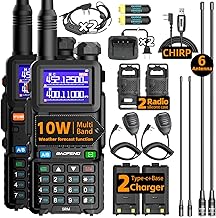
Best for: Buyers seeking a single programmable ham-radio model with rechargeable power. The UV-5RM includes a 2500mAh battery, USB-C charging cable, and desktop charging base. Its 1.77-inch color display and 999 memory channels support channel organization.
The radio receives across several listed frequency ranges and transmits on 144–148 MHz and 420–450 MHz. CHIRP compatibility and the frequency-copy function can simplify setup when managing radio settings or copying from another compatible radio.
Limitation: The wide receiving range does not mean the radio can transmit across every frequency it receives. Users should verify allowed frequencies and licensing requirements before transmitting.
C. Crane CCRadio 3 Portable Radio

Best for: Listeners who want to tune distant broadcast stations rather than communicate with another person by radio. The CCRadio 3 receives AM, FM, NOAA weather, and the 2-meter ham band. Its patented Twin-Coil Ferrite AM Antenna is designed to improve AM reception, while the listed FM design targets weak stations.
Bluetooth adds an option for pairing the radio with a compatible phone or smart speaker. The product also emphasizes clear voice reproduction, which can be useful for talk radio, podcasts, and audio books.
Limitation: This is a listening-focused radio, not a two-way handheld transceiver for sending voice messages to another radio.
SAMCOM FPCN30A 2-Pack

Best for: Work crews that need to contact multiple teams quickly. The FPCN30A offers instant group calling, dual PTT, programmable settings, and 20 UHF channels for separating groups. Its listed 5-watt power and included earpiece suit organized workplace communication.
The product describes a range of 3–5 miles in open areas and building coverage of more than 300,000 square feet. Actual performance depends on terrain, structures, interference, and other conditions, so those figures should not be treated as guaranteed results.
Limitation: The channel and group-call setup may take planning when several teams share the radios. Check applicable rules for the radio’s frequencies and use.
pxton Rechargeable 4-Pack

Best for: Small groups that need several basic handheld radios for outings or coordination. This 4-pack includes earpieces, rechargeable batteries, chargers, and flashlights. It has 16 preset channels, 165 privacy codes, VOX, scanning, and a low-battery alarm.
The listing says the radios work best in open, unobstructed areas and that buildings and other obstacles can reduce range. It also lists 8–12 hours of continuous use, with actual battery life varying according to use.
Limitation: The product does not specify a reliable distance for every environment. Privacy codes help organize channel use but should not be treated as encryption.
Buying Guide: How to Choose a Long Range Portable Radio
Do you need two-way communication or reception?
Choose a handheld transceiver if you need to send and receive messages with another radio. Choose a receiver such as the CCRadio 3 if your priority is listening to broadcast stations, weather information, or ham-band signals. A receiving radio cannot replace a two-way radio when you need to talk back.
What affects real-world range?
Range depends on the radio type, antenna, terrain, buildings, interference, and whether there is a clear path between users. Open areas generally offer better conditions than dense urban settings or interiors with concrete and steel. Treat advertised distances as conditional rather than guaranteed.
How important are channels and programming?
More memory channels can help users organize programmed frequencies, but they do not automatically increase range. Programmable ham radios offer flexibility but require correct setup. Preset-channel radios may be simpler for teams that want to communicate without managing many settings.
What should you check before transmitting?
Confirm the radio’s transmitting frequencies and the rules that apply to those frequencies. In the United States, amateur-radio transmissions generally require an FCC amateur license. Do not assume that a radio’s ability to receive a frequency means it is legal to transmit there.
How should you compare battery and charging options?
Check the included battery capacity, charging accessories, and the manufacturer’s stated operating information. USB-C charging can provide more charging-source options when compatible power is available. Battery life varies with transmission time, settings, and use.
Frequently Asked Questions
Which type of portable radio is best for long-distance listening?
A receiver designed for broadcast reception is the better fit. The C. Crane CCRadio 3 lists AM, FM, NOAA weather, and 2-meter ham-band reception, with a Twin-Coil Ferrite AM Antenna for AM listening.
Do handheld radios always reach their advertised distance?
No. Range changes with terrain, buildings, interference, antenna conditions, and other factors. Open, unobstructed areas typically provide more favorable conditions than built-up environments.
Can I transmit on every frequency a ham radio receives?
No. Receiving coverage and transmitting coverage are different. Check the radio’s stated transmit bands and current FCC requirements before transmitting.
Are privacy codes the same as encryption?
No. Privacy codes can help users coordinate channel access, but they should not be considered a way to encrypt or secure conversations.