When selecting a video wall processor for multi-screen installations, reliability, resolution handling, and flexible splicing options matter most. This guide highlights five top-rated units that balance 4K capability, multiple layout modes, and user-friendly controls for American setups—from retail displays to control rooms. Each product below is evaluated on input/output support, rotation and bezel features, audio handling, and ease of integration with existing AV gear.
| Product | Display Modes | Max Input Resolution | Notes |
|---|---|---|---|
| Portta HDMl Video Wall Controller 2×2 | 8 Modes (2×2, 1×2, 2×1, 1×3, 3×1, 1×4, 4×1, 1×1) | 4K 30Hz input; outputs 1080p 60Hz | Includes 180° rotation and edge masking |
| Uniharpa KS600 | Flexible wall modes; portrait and landscape adjustments | Up to 1920×1200 output; 1920×1080 input | Strong noise reduction and motion compensation features |
| Yuemona 2×2 4K Wall Controller | 2×2, 1×1, 1×2, 1×3, 1×4, 2×1, 3×1, 1×5 | HDMI 4K@30Hz input; 1080p@60Hz output | 180° rotation; edge masking |
| AOGETYO 3×3 Video Wall Controller | 9 modes including 3×3, 1×2, 1×3, 1×4, 2×2, 2×3, 2×4, 3×1, 4×1 | 4K@30Hz input; 1080p outputs | Portrait modes available with rotation |
| Portta 2×2 HDMI/USB-C Video Wall Controller | 11 modes including portrait PC modes and 4×1 | 4K 60Hz input; 4K 30Hz output | Edge/bezel adjustment; audio extraction |
Note: All entries support multiple control methods (manual, IR remote, RS-232) and some offer optical audio output options. When choosing, consider your display matrix, cabling length, and whether you need portrait mode for portrait-oriented signage.
Portta 8-Mode 2×2 Video Wall Controller

The Portta 2×2 video wall processor distributes one HDMI input to four outputs, creating flexible wall configurations. It supports 8 display modes including 2×2, 1×2, 1×3, and 4×1, along with 1×1 splitter mode. Control methods include manual operation, IR remote, and RS232 integration. A notable feature is its 180° rotation in 2×2 mode to align borders with narrow bezels, plus edge masking to minimize visible seams. The device handles 4K 30Hz input and outputs up to 1080p 60Hz, with Toslink and 3.5mm audio extraction for external audio systems. Portrait mode is achievable with PC portrait display settings, expanding placement options for long-sign display walls.
Uniharpa KS600 4K LV Video Wall Processor

The Uniharpa KS600 targets professional video processing with up to 1920×1200 output and 1920×1080 input. It emphasizes adjustable picture quality through brightness and contrast tuning and pixel-level zoom for precise framing. The KS600 also offers noise reduction and motion compensation, which helps maintain clarity in dynamic or medical imagery, reducing noise artifacts and trailing. Its settings enable fine-tuning for long-throw displays or LED walls, and the front-panel design supports straightforward operation. This unit is suited for installations where precise color and motion handling are critical, such as retail windows or control room signage.
Yuemona Video Wall Controller 2×2 4K
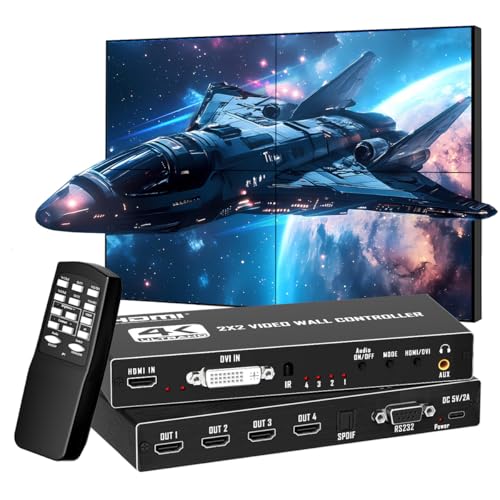
Yuemona’s 2×2 video wall controller distributes one HDMI or DVI input to four outputs, enabling a full wall display from a single source. It supports 4K at 30Hz input and 1080p at 60Hz output, with additional 5.1 channel audio and 3.5mm audio output options via optical or analog connections. The model supports 180° screen rotation for border-leaning bezeled walls and includes edge masking to minimize distortions at seams. This is a practical choice for dynamic storefronts or event walls, where a single source must drive multiple screens with synchronized playback and clean visual seams.
AOGETYO 3×3 LED Wall Controller

The AOGETYO 3×3 video wall controller handles nine outputs from a single HDMI input in a matrix arrangement, delivering a large, tiled display. It supports 4K input at 30Hz and 1080p outputs across all tiles, with 13 available splicing modes including 3×3, 2×3, 4×2, and more. Each mode has hotkey remote control and button selection for straightforward switching, with RS232 for advanced control. The device also supports vertical portrait layouts by rotating inputs and offers edge masking to minimize distortion at seam lines. This option is well-suited for expansive digital signage walls in showrooms or atriums that require dense screen matrices.
Portta 2×2 HDMI/USB-C Video Wall Controller

This Portta model supports HDMI or USB-C inputs feeding four HDMI outputs, delivering 11 display modes, including portrait PC modes. It handles 4K 60Hz input and provides 4K 30Hz outputs, along with audio extraction via Toslink and 3.5mm. The unit offers 180° image rotation and bezel adjustment, allowing edge trimming in 8-pixel increments to keep content visually balanced on multi-screen walls. Superior for venues needing high bandwidth from USB-C sources or traditional HDMI setups, with flexible layout options for retail or event spaces.
Buying Guide: Key Purchase Considerations
When choosing a video wall processor, consider the following factors to match your project goals:
- Display matrix and resolution: Ensure the processor supports your target matrix (2×2, 3×3, etc.) and the required input/output resolutions (4K/60Hz vs 4K/30Hz).
- Splicing modes and orientation: Look for a device offering the exact layouts you need (horizontal, vertical, or mixed) and portrait capabilities if your wall will rotate for signage or portrait displays.
- Bezel compensation and edge handling: Bezel correction or masking minimizes seams and provides a more cohesive image across tiles.
- Control methods: RS-232, IR, and manual control compatibility matter for integrated AV systems and centralized control rooms.
- Audio support: Decide whether you need optical/Toslink outputs or analog 3.5mm to drive external speakers or audio matrices.
- Scalability and reliability: Consider potential future expansion (additional tiles) and the processor’s fan noise, heat dissipation, and reliability.
- Connectivity: Ensure input sources include HDMI and/or USB-C as needed, plus compatibility with DVI if used in legacy setups.
- Installation environment: For bright storefronts or large venues, verify brightness handling, latency, and color accuracy across screens.
In summary, the right LED video wall processor hinges on matching your screen array, preferred input sources, and control workflow. The reviewed options provide a spectrum from compact 2×2 configurations with broad mode support to larger 3×3 matrices with advanced portrait capabilities. Evaluating the combination of resolution, bezel treatment, and control compatibility will guide the best fit for steady, professional multi-screen displays.