The best lead acid battery test equipment depends on what you need to measure: remaining capacity, battery-cell condition, or automotive starting and charging performance. The two 6V/12V intelligent analyzers are best for checking stated amp-hour capacity; the ACT 612 is an option for buyers seeking that named tester; the EZRED hydrometer is best for acid-specific checks; and the TOPDON BT100 is better suited to 12V vehicle diagnostics.
| Equipment | Best for | Test focus |
|---|---|---|
| 6V/12V intelligent tester | Mixed lead-acid battery types | Voltage and remaining Ah |
| ACT 612 tester | Buyers seeking the ACT 612 model | Lead-acid battery testing |
| EZRED SP101 hydrometer | Battery acid checks | Specific gravity |
| TOPDON BT100 | 12V vehicle owners | Health, cranking, and charging |
6V/12V Intelligent Capacity Tester

This tester is best for buyers who need an amp-hour capacity estimate across several common lead-acid battery types. It supports 6V batteries from 1.2Ah to 10Ah and 12V batteries from 1.2Ah to 100Ah. Listed compatible types include SLA/AGM, GEL, flooded, and car starting batteries.
The analyzer simulates a C20, or 20-hour, discharge test and displays DC voltage and remaining Ah capacity in seconds, according to the product information. Its stated reverse-polarity warning and 30VDC over-voltage protection can help reduce connection errors. It also includes an ABS body and protective holster.
Choose this if you want a quick capacity-focused check for batteries in vehicles, boats, mobility scooters, golf carts, security systems, or UPS equipment. Limitation: its listed voltage and capacity ranges are limited to 6V and 12V batteries within the specified Ah ranges.
6V/12V Lead-Acid Ah Analyzer

This is another capacity-oriented choice for users checking 6V and 12V lead-acid batteries. Its stated ranges are 1.2Ah–10Ah for 6V and 1.2Ah–100Ah for 12V. It is listed for SLA/AGM, GEL, flooded, and car starting batteries, including applications such as trucks, boats, scooters, golf carts, and UPS systems.
Like the first analyzer, it simulates a C20 discharge test and reports DC voltage and remaining amp-hour capacity. The feature list says the test does not consume battery power and identifies reverse-polarity protection, a warning indicator, and 30VDC over-voltage protection. The housing is described as ABS with a protective cover.
Best for buyers comparing a similar feature set for workshop, garage, or field use. Limitation: the listed functions emphasize voltage and capacity; the product details do not list dedicated cranking or charging-system tests.
ACT 612 Intelligent Battery Tester

The ACT 612 is best for shoppers specifically looking for a lead-acid intelligent tester identified by this model name. The product name states support for SLA, gel, and flooded batteries. It may suit users who want a dedicated tester for those battery chemistries rather than a general-purpose electrical meter.
Why it is included: it directly matches the lead-acid battery testing topic and names several common battery types. The available listing information does not provide detailed measurement ranges or testing functions, so compare the product’s current specifications with your battery voltage and diagnostic needs before choosing it.
Limitation: the supplied product details do not specify capacity range, display readings, safety protections, or whether it performs cranking and charging tests.
EZRED SP101 Battery Hydrometer

The EZRED SP101 is best for users who need to inspect battery acid condition using a hydrometer. Its listed range is 1.100–1.300, and the product description says it is designed to make acid readings visible to both a customer and a technician. It is described as rugged and intended for service stations and garages.
The product information says its reading method avoids difficult float reading and the need for temperature tables. That makes it a focused tool for battery technicians, mechanics, or other users checking acid condition.
Choose this if acid-specific readings are part of your maintenance routine. Limitation: a hydrometer measures battery acid condition; it does not provide the listed electronic voltage, amp-hour, cranking, or charging-system results of the other testers.
TOPDON BT100 12V Battery Tester
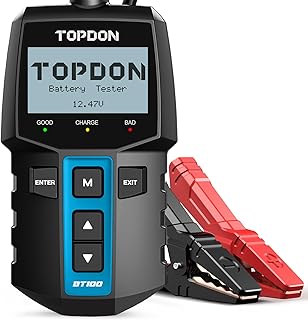
The TOPDON BT100 is best for vehicle owners who want 12V battery and starting-system diagnostics. It reports state of health, state of charge, voltage, current, and rating. Its stated compatibility includes 100–2000 CCA regular flooded, AGM flat-plate or spiral, EFB, and GEL batteries.
Its listed test functions cover battery health, engine cranking, and charging-system checks, including charging current, rectifier diode, and generator operation. The passive testing approach means the unit powers on when properly attached, according to the product details. Applications listed include cars, motorcycles, trucks, RVs, boats, and lawnmowers.
Better for automotive troubleshooting than for measuring small 6V battery capacity. Limitation: it is specified as a 12V tester and does not list the 6V support or Ah capacity ranges of the intelligent analyzers.
Buying Guide: Choosing Lead Acid Battery Test Equipment
What battery voltage and capacity do you need to test?
Check the battery’s nominal voltage and amp-hour rating before buying. The two intelligent analyzers list support for 6V and 12V batteries, with different Ah ranges for each voltage. The TOPDON BT100 is specified for 12V automotive batteries, while the ACT 612 listing provided here does not state voltage or capacity limits.
Do you need capacity, acid, or vehicle-system results?
- For remaining Ah and voltage: consider an intelligent capacity analyzer with ranges that match your battery.
- For acid condition: consider the EZRED hydrometer and its stated specific-gravity range.
- For cranking and charging checks: consider the TOPDON BT100, which lists those functions.
Which battery chemistry is supported?
Confirm that the tester covers your battery type. The intelligent analyzers list SLA/AGM, GEL, and flooded batteries. The TOPDON BT100 lists regular flooded, AGM, EFB, and GEL. A product name alone may not provide enough detail to verify every operating range, so check the full specifications before purchase.
Are safety features and use conditions important?
For electronic analyzers, look for clear connection instructions and protection features. The two capacity testers list reverse-polarity protection and 30VDC over-voltage protection. Follow the manufacturer’s directions, and choose a tool that measures the specific result you need rather than relying on voltage alone to answer every battery-health question.
Frequently Asked Questions
What does a lead-acid battery tester measure?
Depending on the tool, it may measure voltage, estimated state of charge, amp-hour capacity, acid specific gravity, cranking performance, or charging-system operation.
Can one tester check both 6V and 12V batteries?
The two listed intelligent capacity analyzers specify both 6V and 12V support. The TOPDON BT100 is specified for 12V batteries. Check the product range before connecting any tester.
Is a hydrometer the same as an electronic battery tester?
No. A hydrometer checks battery acid specific gravity. Electronic testers can provide electrical measurements or diagnostic results, depending on the model.
Which tester is better for checking a car’s charging system?
The TOPDON BT100 lists charging-system and cranking tests in addition to battery health checks. The supplied details for the capacity analyzers focus on voltage and remaining Ah.