The best indoor cell phone antenna depends on the coverage pattern and equipment you need. Choose the XRDS-RF directional panel for a targeted area, the ZDTECH panel for a wider stated frequency range, or the XRDS-RF dome for 360-degree coverage. The qishun antenna is a simple omnidirectional option, while the weBoost Home MultiRoom is a complete signal booster system rather than a standalone antenna.
| Product | Best For | Type |
|---|---|---|
| XRDS-RF Indoor Panel | Targeted coverage | Directional antenna |
| ZDTECH Indoor Panel | Priority areas and corridors | Directional antenna |
| XRDS-RF Dome | Coverage in multiple directions | Omnidirectional antenna |
| weBoost Home MultiRoom | Multiroom cellular improvement | Signal booster system |
| qishun Indoor Antenna | Basic omnidirectional setup | Omnidirectional antenna |
XRDS-RF Indoor Panel Antenna

This directional panel antenna is best for a room, work area, or larger space where signal should be aimed in a particular direction. The listing specifies operation from 698 to 2700 MHz, up to 8 dB gain, 50-ohm impedance, and an N-Female connector. It includes a wall-mount bracket and a one-foot KMR240 cable.
Choose this model if your signal booster accepts an N-Female connection and you want a wall-mounted antenna aimed toward a priority area. Its directional design is more focused than an omnidirectional antenna. Avoid choosing it for evenly distributed, all-around coverage unless your booster setup and room layout support that placement.
ZDTECH Wide-Band Indoor Panel Antenna

The ZDTECH panel is best for a defined priority area, such as a corridor or home office. Its listing describes a directional, wall-mounted, 50-ohm antenna with an N-Female connector and up to 9.5 dB gain. The product name states a 698–4000 MHz frequency range, while the feature text gives a conflicting range. Confirm the correct specification with the seller before buying.
Compared with the XRDS-RF panel, this model lists higher maximum gain and a broader frequency range in its name. Choose it if those specifications match your signal booster. Its directional pattern is a limitation if you need coverage distributed in every direction.
XRDS-RF Omnidirectional Dome Antenna
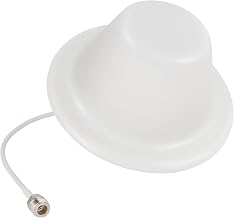
This ceiling-style antenna is best when indoor coverage needs to spread in multiple directions. It provides 360-degree coverage and lists 3 dBi gain, 50-ohm impedance, an N-Type Female connector, and a 698–2700 MHz range. The housing is described as UV-protected ABS.
Choose this dome over a panel antenna when an all-around pattern better suits the room. It is not the strongest listed option by stated gain, and its frequency range is narrower than the range given in the ZDTECH product name. Confirm that both its connector and frequency range match your equipment.
weBoost Home MultiRoom Signal Booster

This product is best for buyers who want a multiroom signal-boosting system rather than an antenna alone. The listing says it can cover up to 5,000 square feet or three to four rooms, and it is designed to boost cellular signal for devices on any U.S. carrier. Listed power requirements are 110–240 V AC, 50–60 Hz, and 8 W; listed impedance is 75 ohms.
Choose this system if you need a broader home solution and do not want to select only an indoor antenna. The listing’s coverage claim is a maximum, not a guarantee for every building. This product has different stated impedance from the standalone 50-ohm antennas above, so do not assume components are interchangeable.
qishun Indoor Omni-Directional Antenna

The qishun antenna is best for buyers seeking a straightforward omnidirectional antenna for a compatible cell phone signal booster. It lists a 698–2700 MHz frequency range, 50-ohm impedance, an N-Male connector, and 2–5 dBi gain.
Its all-around pattern may suit a setup where coverage should not be aimed at just one area. The product information provided is brief and does not specify mounting hardware or a cable. Check the connector and installation requirements before purchase, especially when comparing it with antennas that use N-Female connectors.
Buying Guide: How to Choose an Indoor Cell Phone Antenna
Do you need directional or omnidirectional coverage?
A directional panel sends signal toward a particular area. It can be a better fit for a room or corridor that needs focused coverage. An omnidirectional antenna spreads coverage in multiple directions and may suit open spaces where users are spread around the antenna. Placement and the connected booster affect the final result.
Will the antenna connect to your equipment?
Check the connector type before buying. These products list N-Female or N-Male connectors, and the weBoost system lists 75-ohm impedance while several standalone antennas list 50 ohms. Match the antenna to the signal booster or router requirements rather than assuming the connections are compatible.
Which frequency range should you compare?
Compare the antenna’s stated frequency range with the bands supported by your equipment and the cellular service you need. A wider advertised range does not by itself guarantee improved reception. When product specifications conflict, as with the ZDTECH listing, verify the exact range before purchase.
Is an antenna enough, or do you need a booster?
A standalone indoor antenna is a component for a compatible system; it is not the same as a complete signal booster. If you do not already have suitable equipment, compare a full booster system such as the weBoost Home MultiRoom with individual antennas. Confirm the system’s coverage and installation requirements for your building.
Frequently Asked Questions
What does an indoor cell phone antenna do?
It receives or distributes cellular signal as part of a compatible booster or related system. An antenna alone does not necessarily boost a phone’s signal.
Is a panel antenna better than a dome antenna?
Neither is universally better. A panel antenna is directional and suits targeted coverage; a dome antenna provides an omnidirectional pattern for coverage in multiple directions.
Can I connect any antenna to my signal booster?
No. Check connector type, impedance, frequency range, and the booster’s requirements before connecting an antenna.
Does a higher gain number guarantee better indoor signal?
No. Gain is one specification, but antenna direction, placement, frequency support, and the connected equipment also matter.
Should I buy a standalone antenna or a signal booster system?
Choose a standalone antenna if you have compatible equipment and need an indoor antenna component. Consider a complete booster system if you need a broader solution and do not already have the required setup.