The best high-power stereo receiver depends on whether you need strong two-channel audio, multiple speaker zones, or karaoke and home entertainment connections. The Sony STRDH190 is a practical pick for two-channel listening with a stated 100 watts per channel, while the Donner four-channel receiver suits multi-speaker setups. For karaoke and varied inputs, consider the Pyle or Donner models with microphone connections. Compare RMS output where provided; peak-watt figures are not directly comparable to continuous power.
| Receiver | Best For | Power Information |
|---|---|---|
| Sony STRDH190 | Two-channel home audio | 100 watts × 2 at 8 ohms |
| Donner 4-Channel | Multiple speaker groups | 25 watts × 4 RMS; 1,000-watt peak |
| Pyle PDA77BU | Karaoke and events | 800-watt peak |
| Donner 2-Channel MAMP2 | Stereo plus phono and digital inputs | 60 watts × 2 RMS; 600-watt peak |
| Pyle 6-Channel Hybrid | Multi-speaker entertainment | 2,000-watt peak |
Sony STRDH190 Two-Channel Receiver

Best for: Buyers who want a straightforward two-channel receiver with a clearly stated output rating. Sony lists 100 watts per channel at 8 ohms, making this a useful comparison point when shopping for a conventional stereo system.
The STRDH190 includes a phono input for a turntable, four stereo RCA audio inputs, a 3.5 mm input, Bluetooth, and a stereo RCA output. Its speaker impedance range is listed as 6–16 ohms. Choose this model if your priority is stereo listening and analog source connections rather than multichannel speaker distribution.
Limitation: It is a two-channel receiver, not a four- or six-channel system. Check speaker impedance and connection needs before buying.
Donner Four-Channel Receiver With Digital Inputs

Best for: Households that want to control multiple speaker groups or connect karaoke microphones. Donner specifies 1,000 watts peak power and 25 watts × 4 RMS power. The RMS figure is the more useful listed measure for comparing continuous output.
The receiver supports four independently controlled channels and up to four groups of eight speakers, with 4–8-ohm speakers, according to the product information. Inputs include Bluetooth 5.3, USB, two pairs of RCA, AUX, FM radio, optical, coaxial, and two microphone inputs. It also provides treble, midrange, bass, echo, and talkover adjustments.
Limitation: It has no HDMI input. The listing also advises checking whether a TV needs its external audio output mode selected when using a digital connection.
Pyle PDA77BU Karaoke Receiver

Best for: Buyers who need a receiver for karaoke, presentations, or casual home audio and value microphone controls. Pyle advertises 800 watts of peak power, Bluetooth 5.0, and dual 1/4-inch microphone inputs with independent controls.
Other listed features include USB-A playback, an MP3 player, SD card support, FM radio, and RCA input and output. Bluetooth streaming is specified for compatible phones, tablets, laptops, and other devices, with a stated range of more than 30 feet. Choose it when microphone functionality and several everyday source options matter.
Limitation: The supplied product information gives peak power but not an RMS output rating. Do not compare the 800-watt peak figure directly with another receiver’s RMS rating.
Donner MAMP2 Two-Channel Receiver

Best for: Stereo listeners who want a turntable connection, digital TV inputs, and a stated continuous power figure. Donner lists 60 watts × 2 RMS and 600 watts peak, plus support for 4–8-ohm speakers.
Inputs include Bluetooth 5.3, USB, RCA, AUX, FM radio, phono, optical, and coaxial. The receiver also has two microphone inputs, treble, midrange, bass, echo, and talkover controls. Product information says it supports up to two groups of four speakers and one subwoofer.
Limitation: There is no HDMI input. Confirm that the receiver’s listed speaker and source connections match your system before choosing it.
Pyle Six-Channel Hybrid Amplifier Receiver
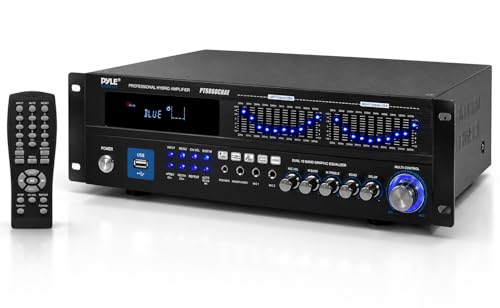
Best for: Buyers building a multi-speaker entertainment or karaoke setup who need many connection options. Pyle advertises 2,000 watts of peak power for this six-channel hybrid amplifier and lists compatibility with multi-speaker use at 4 ohms.
Its listed connections include Bluetooth, USB, AUX, two microphone inputs, headphone output, optical, coaxial, HDMI, AC-3, and DVD inputs. It also includes FM radio and a dual 10-band equalizer. This model is a better fit for feature-heavy home entertainment than for someone seeking a simple two-channel receiver.
Limitation: The stated power is peak power, and the supplied information does not provide an RMS rating. Check the channel and speaker requirements for your intended setup.
Buying Guide: How To Choose A High-Power Stereo Receiver
How should I compare receiver power?
Look for RMS or continuous power per channel and note the speaker impedance used for that rating. Peak power is a maximum-style marketing figure and should not be treated as equivalent to RMS output. In this selection, the Sony lists 100 watts × 2 at 8 ohms, while the Donner MAMP2 lists 60 watts × 2 RMS.
Do you need two, four, or six channels?
A two-channel receiver is suited to a conventional left-and-right stereo system. Four-channel models can serve multiple speaker groups, while a six-channel unit may suit more complex entertainment arrangements. More channels do not automatically mean greater output per speaker; check the per-channel rating and supported speaker configuration.
Which connections matter most?
For turntables, look for a phono input, as found on the Sony and Donner MAMP2. For televisions, optical or coaxial inputs may be useful; the listed Donner models include these connections. If you need HDMI, verify the exact model’s input support, since some receivers in this selection explicitly lack it.
Are microphone inputs important?
Choose a receiver with microphone inputs and suitable controls if you plan to host karaoke, announcements, or presentations. The Pyle PDA77BU and both Donner models list microphone inputs. For music-only listening, those features may be unnecessary.
Frequently Asked Questions
What does high power mean in a stereo receiver?
It generally refers to the receiver’s ability to deliver audio output, but the rating must be read in context. Compare RMS watts per channel, impedance, and channel count rather than relying on peak watts alone.
Is a four-channel receiver better than a two-channel receiver?
Not necessarily. Four channels can support more speaker groups, while a two-channel receiver may be a better match for a standard stereo setup with a clearly stated per-channel output.
Can I connect a turntable to any receiver here?
No. Check for a phono input before buying. The Sony STRDH190 and Donner MAMP2 list phono inputs; the other product details do not specify one.
Should I match receiver power to my speakers?
Check the speakers’ impedance and power guidance against the receiver’s specifications. The product information provided here does not include complete matching guidance for every receiver and speaker combination.