The best high-power cooling fan depends on whether you need whole-room air circulation, a concentrated breeze, or quiet airflow for sleep. The DREO Smart Fan is best for app and voice controls, the DREO 90-foot circulator suits broad room coverage, and the Lasko utility fan is better for aiming airflow at a specific area. The options below compare reach, controls, oscillation, and noise claims so you can match a fan to your space.
| Fan | Best For | Notable Feature |
|---|---|---|
| DREO Smart Fan | Connected whole-room use | App and voice controls |
| DREO 90-foot Air Circulator | Bedroom or living room circulation | 90-foot stated airflow reach |
| DREO 28ft/s Tower Fan | Quiet, adjustable bedroom airflow | Eight speeds and four modes |
| DREO 120° Pedestal Fan | Wide directional coverage | Horizontal oscillation and manual tilt |
| Lasko Utility Fan | Targeted airflow and utility tasks | 270-degree pivot and two outlets |
DREO Smart Fan For Connected Whole-Room Airflow

This DREO pedestal fan is best for people who want broad circulation plus app or voice control. Its listed features include airflow up to 100 feet, 1,000 CFM, nine speeds, and six modes. The product description specifies circulation for spaces up to 105 square feet and includes Auto Mode, which adjusts speed based on temperature changes.
Use the app, voice commands, or remote to control speed, modes, oscillation, timers, and Turbo mode. Its 120-degree horizontal and vertical oscillation is intended to direct air across a wide area. The stated noise level is 20 dB. Choose it if connected controls matter; avoid it if you only need a simple, manually operated fan.
DREO 90-Foot Air Circulator For Quiet Rooms
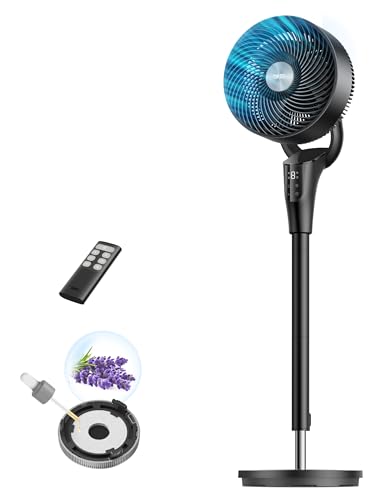
This model is best for buyers who want room circulation with adjustable positioning. DREO lists airflow reach up to 90 feet and 1,000 CFM. It has 90-degree horizontal oscillation, a 105-degree pivoting head, and height adjustment from 38 to 42 inches, giving it more placement flexibility than a fixed-height tower fan.
The DC motor and bionic blade design are listed at 20 dB, and the fan includes an eight-hour timer and a remote with a mute function. Choose it for a bedroom or shared room where direction and quiet operation matter. A limitation is that it has three modes, fewer than the four or six modes offered by some alternatives.
DREO Tower Fan For Strong, Quiet Airflow

This DREO tower fan is best for buyers who want strong stated air speed in a compact standing format. Its brushless DC motor and TurboWind technology are listed with wind speeds up to 28 feet per second and projection up to 34 feet. Eight speed settings and Normal, Natural, Sleep, and Auto modes provide several ways to adjust airflow.
The product description lists noise as low as 20 dB and includes a remote and touch screen. Choose this option for a bedroom or office where speed choices and quiet-focused features are priorities. Its tower design provides less adjustable height and head positioning than the pedestal models in this comparison.
DREO 120° Pedestal Fan For Wide Coverage

This DREO pedestal fan is best for users who want adjustable height and a broad sweep of airflow. It combines pedestal, oscillating, and air-circulator functions, with nine speeds, four modes, and stated airflow reach up to 100 feet. Its horizontal oscillation spans 120 degrees, while vertical tilt can be adjusted manually through 120 degrees.
The listed noise level is 20 dB, and the fan includes an eight-hour timer, remote, and LED display. Choose it when you want to adjust airflow direction as well as speed. Keep in mind that vertical tilt is manual, while horizontal oscillation is controlled using the remote or panel.
Lasko Utility Fan For Targeted High-Velocity Air

The Lasko utility fan is best for directed airflow in a garage, office, or work area. It is a compact, 12-inch portable model with three speeds and stated airflow up to 289 CFM. The housing pivots 270 degrees, allowing the airflow to be aimed upward, downward, or at an angle. The product description also notes that it can be used to help dry freshly mopped floors or paint.
Two built-in grounded outlets and a 10-foot power cord add utility for nearby tools or devices. Choose this fan for focused airflow rather than broad, oscillating room coverage. Its three speeds and targeted blower design make it less suited to buyers seeking multiple sleep modes or wide automatic oscillation.
Buying Guide: How To Choose A High-Power Cooling Fan
Do you need room circulation or a direct breeze?
Airflow reach and CFM describe different stated aspects of a fan’s output. Reach figures can help compare how far a product claims to move air, while CFM indicates airflow volume. Neither figure alone guarantees the same comfort in every room. For a focused breeze, a pivoting utility fan is practical. For wider coverage, consider an oscillating pedestal or tower model.
How important are noise and speed options?
For bedrooms, compare the listed noise claims, sleep modes, and timer functions. The DREO options in this list state noise levels of 20 dB, while the Lasko listing does not provide a noise figure. More speeds and modes can offer finer adjustments, but a simpler three-speed fan may be enough for a work area.
Which controls and adjustments will you use?
A remote is useful when the fan is across the room. App and voice controls suit buyers who want connected operation. Check whether vertical direction is motorized or manual: the DREO 120-degree pedestal model requires manual vertical tilt, while the other DREO pedestal listing provides a pivoting head and adjustable height.
What should you check before buying?
Measure the intended spot, confirm the fan’s listed height and footprint, and consider whether its airflow direction fits your layout. For utility use, check outlet and cord details. For whole-room circulation, compare oscillation range and stated airflow claims. Fan specifications describe product capabilities, not a guarantee of a particular room temperature or cooling result.
Frequently Asked Questions
What is the best type of fan for whole-room airflow?
An oscillating pedestal or tower fan can spread airflow across a wider area. Compare each model’s stated reach, oscillation, and available placement adjustments.
Is a high-velocity fan the same as an air circulator?
Not necessarily. A high-velocity utility fan may direct a strong stream at a specific spot, while an air circulator is designed to move air around a room.
Which fan is best for a quiet bedroom?
The DREO tower and pedestal models list noise levels as low as 20 dB and include sleep-oriented features. Check the product details to confirm which modes and controls suit your routine.
Does a higher CFM number mean a fan cools a room better?
CFM is a measure of airflow volume, not a direct measure of room cooling. Room layout, placement, and airflow direction also affect how comfortable a fan feels.