The best HDMI-to-digital-RF modulator depends on whether your TVs need a digital ATSC or QAM channel, or an older analog RF signal. The SatLink ST-7000 is the clearest fit for digital ATSC or QAM distribution, while the Thor Broadcast model supports several digital broadcast formats. The other three options are described as analog RF converters, making them better suited to compatible legacy televisions and equipment.
| Product | Best For | Output Type |
|---|---|---|
| SatLink ST-7000 | HD distribution on ATSC or QAM | Digital ATSC or QAM |
| Thor Broadcast HDMI Modulator | Multiple digital broadcast formats | Digital; listed formats vary |
| kurtmark HDMI to RF | Basic CH3/CH4 connections | Analog NTSC |
| HDMI/CVBS VHF-UHF Modulator | HDMI or RCA input options | RF; verify format needs |
| HDM61 HDMI to RF | NTSC legacy TV setups | Analog NTSC |
SatLink ST-7000 Digital RF Modulator

The SatLink ST-7000 is the most directly relevant choice for sending HDMI video to televisions over a coax network using a digital channel. Its listed capabilities include delivering 1080p HDMI video as an HD ATSC or QAM (J.83B) channel. That makes it a better match than a CH3/CH4 analog converter when the receiving TVs and distribution system are set up for digital RF.
Best for: Homes or installations that need an HDMI source distributed as an ATSC or QAM channel. It was selected because the product name explicitly identifies both digital output types.
Check before buying: Confirm that the televisions or tuners support the chosen ATSC or QAM format. The provided product information does not specify additional input resolutions, setup controls, or included accessories.
Thor Broadcast Multi-Format Modulator

The Thor Broadcast modulator encodes HDMI audio and video for RF distribution. Its listed formats include DVB-C/T, ATSC, and ISDB-T, and the product description also refers to HD CATV QAM. Supported source resolutions are listed as 720p, 1080i, and 1080p. The description identifies MPEG-2 encoding and AC3 Dolby Audio.
Best for: Buyers who need a digital modulator with several listed broadcast formats, or who are distributing a source such as a set-top box, satellite receiver, HDMI camera, DVD player, or computer. It offers broader format choices than products limited to NTSC CH3/CH4.
Check before buying: Match the selected output format to the receiving televisions and head-end equipment. The product description lists multiple standards, so verify the exact mode required for your installation.
kurtmark HDMI To RF Converter

This plug-and-play converter changes an HDMI input into analog NTSC RF on channel 3 or 4. The listing gives the corresponding frequencies as 61.25 MHz and 67.25 MHz. It supports HDMI input resolutions up to 1080p, along with 1080i, 720p, 576p, and 480p, and includes a 1.2-meter HDMI cable and power adapter.
Best for: A buyer connecting an HDMI device to an older television or RF-input display that accepts NTSC channel 3 or 4. The included cable and stated PLL control are useful details for a straightforward setup.
Limitation: This is not a digital ATSC or QAM modulator. The listing also states that conversion works from HDMI to RF only, not from RF to HDMI; 1080p describes the input, not the RF output.
HDMI And CVBS VHF/UHF RF Modulator

This converter lists both HDMI and CVBS RCA inputs, plus VHF and UHF RF output through F female connectors. Its supported input resolutions include 1080p, 1080i, 720p, 576p, 576i, and 480p. The product description mentions PAL and NTSC formats and says that no driver installation is required.
Best for: Users who want one RF converter for either an HDMI source or a composite RCA source. The two input types give it a different use case from HDMI-only models.
Limitation: The supplied details do not identify an ATSC or QAM digital output mode. Buyers seeking a digital RF channel should confirm the output standard before choosing it.
HDM61 NTSC HDMI RF Adapter
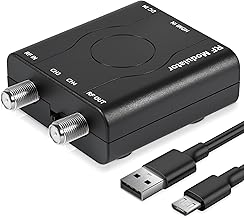
The HDM61 converts HDMI input to NTSC RF on VHF channel 3 or 4, listed at 61.25 MHz and 67.25 MHz. It supports HDMI input resolutions from 480p through 1080p, including 576i and 1080i, and lists devices such as PCs, game consoles, cameras, TV boxes, DVD players, CCTV, and DVR equipment as possible sources.
Best for: Buyers who need a basic NTSC RF connection for a compatible legacy TV or RF-input setup. It was selected for its clearly stated channel frequencies and broad list of source-device types.
Limitation: The listing describes NTSC output, not ATSC or QAM digital output. Choose another model if your installation requires a digital broadcast channel.
Buying Guide: How To Choose An HDMI RF Modulator
Do you need digital ATSC/QAM or analog NTSC?
This is the key decision. ATSC and QAM are digital RF standards; NTSC CH3/CH4 output is analog. A digital modulator is generally the relevant category when a television or tuner must find a digital channel over coax. An analog converter is appropriate only when the receiving equipment supports the analog signal it outputs. Do not assume that the word “HDMI” means the RF output is high-definition or digital.
Will every TV on the coax network receive the signal?
Check the tuner standard supported by each television, not just the source device. A modulator may send one RF channel across a coax network, but each receiving TV must be able to tune that channel and decode its format. For multiple televisions, also confirm that the existing coax distribution arrangement supports the intended signal.
Which source resolutions and connections matter?
Compare the modulator’s supported HDMI input resolutions with the output settings available on your source. If the source can use several resolutions, choose a setting explicitly listed by the product. Buyers with older composite equipment should consider a model that names CVBS or RCA input. Check connector type and any required cables or power accessories before installation.
How should you compare channels and setup requirements?
For analog devices, confirm the channel and frequency match the receiving TV’s tuning options. The kurtmark and HDM61 listings specify NTSC channels 3 and 4. For digital models, identify the required standard—such as ATSC or QAM—and check that it matches both the television tuner and distribution equipment. Treat resolution claims as input capabilities unless the listing specifically explains the RF output resolution.
Frequently Asked Questions
Is an HDMI-to-RF modulator the same as an RF-to-HDMI converter?
No. An HDMI-to-RF modulator sends an HDMI source to an RF/coax connection. It does not necessarily convert an incoming RF signal into HDMI.
Can an NTSC CH3/CH4 converter send a digital ATSC channel?
Not based on the listed specifications for the analog models here. They specify NTSC RF output, while ATSC is a digital standard.
Does 1080p input mean the coax output is 1080p?
No. A stated 1080p input capability describes the signal accepted from the HDMI source. It does not, by itself, establish the resolution or format of the RF output.
What should I check before connecting a digital modulator?
Confirm the modulator’s output standard, the tuner standard supported by each TV, and whether the coax distribution system can carry the selected channel.