Discover top desktop 3D laser scanners designed for precise measurements, fast captures, and ease of use. This guide profiles five models that balance accuracy, speed, and workflow compatibility for professionals and enthusiasts in engineering, design, and manufacturing. Each entry highlights core capabilities, suitable applications, and key features to help you compare options at a glance.
| Product | Brand | Approx. Accuracy | Scanning Speed | |
|---|---|---|---|---|
| Revopoint MetroX | Revopoint | 0.01–0.02 mm | Up to 60 fps | Blue laser, metrology-grade options, dark/ shiny surfaces |
| 3DMakerpro Mole | 3DMakerpro | 0.05 mm | Up to 10 fps | Near-infrared facial scanning; anti-shake |
| Revopoint MIRACO Plus | Revopoint | 0.02 mm | High throughputs with quad depth cam | Photogrammetry kit included; color capture |
| Creality CR-Scan Raptor | CREALITY FALCON | 0.02 mm | Up to 60 fps | Blue laser plus NIR options; anti-shake |
| Creality Sermoon S1 | Creality | 0.02 mm | Up to 4.6M measurements/s | Wireless scan bridge; color texture mapping |
Revopoint MetroX 3D Scanner

The MetroX is a handheld, industrial-grade blue laser scanner designed for high-precision metrology and industrial measurement tasks. It delivers accurate point clouds with a fused distance near 0.05 mm and a precision as tight as 0.01 mm. Four effective scanning modes—including Full-field and Auto Turntable—support a range of objects and surfaces, from mechanical parts to molds. Its GPU-accelerated blue laser lines enable fast scanning, up to 60 frames per second, with a strong emphasis on accuracy over speed for demanding applications. Note that the laser is Class 2M, so eye safety should be observed.
3DMakerpro Mole 3D Scanner

The Mole 3D Scanner combines a compact handheld design with a high-precision output, delivering 0.05 mm accuracy and a 200×100 mm capture range. It supports common formats such as OBJ, STL, and PLY for quick use in typical 3D printing workflows. Anti-shake lenses and optical stabilization help maintain stable scans in handheld mode, while a safe IR light source is suitable for facial scanning in certain configurations. With a 10 fps scanning rate, it balances speed and detail for mid-size objects.
Revopoint MIRACO Plus 3D Scanner

The MIRACO Plus blends photogrammetry with a handheld scanning system, enabling detailed color scans and high-accuracy 0.02 mm metrology. Its quad depth camera system and integrated RGB camera deliver versatile scanning across small to large objects. The Photogrammetric Kit increases length accuracy to 0.02 mm with 0.05 mm x L(m) term. A 32 GB RAM configuration supports smoother pipelines, and color textures add lifelike realism to captured models. The device is designed for users seeking color-accurate scans alongside precise geometry.
Creality CR-Scan Raptor 3D Scanner

The Raptor Pro combines 22 cross laser lines with 7 parallel lines to cover diverse object sizes efficiently, delivering metrology-grade 0.02 mm accuracy. It supports both blue laser scanning and NIR options, allowing marker-based or marker-free workflows. The One-Shot imaging system and anti-shake design help reduce data loss during handheld scanning, making it suitable for automotive and engineering parts, as well as mid-size components. The dual-mode capability supports quick scans with strong detail preservation.
Creality Sermoon S1 3D Scanner
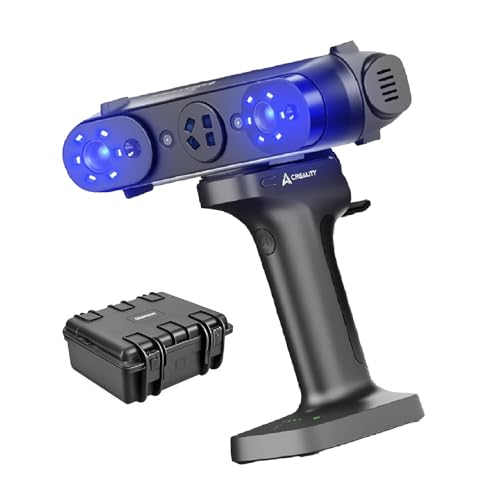
The Sermoon S1 combines blue laser and structured light capabilities with wireless scanning via its Scan Bridge. It achieves up to 0.02 mm detail accuracy and supports high-volume measurements with a robust scan speed. The color texture mapping feature enhances realism by capturing surface colors, while wireless connectivity streamlines workflow and reduces cable clutter. The included calibration board and quick-start guide support a smoother initial setup for industrial design and reverse engineering tasks.
Buying Guide: Key Purchase Considerations
- Accuracy vs. speed: Higher accuracy (0.02–0.01 mm) often comes at the cost of speed. Choose based on whether fine detail or rapid prototyping matters more for your projects.
- Surface versatility: Blue laser, photogrammetry, and NIR options affect how well dark or shiny surfaces scan. Consider objects you frequently digitize (metal parts, dark finishes, reflective surfaces).
- Workflow integration: Look for compatibility with Windows and macOS, common file formats (OBJ, STL, PLY), and whether color texture data is important for your use case.
- Ease of use: Handheld vs. desktop, auto turntables, and anti-shake features impact setup time and user experience, especially for beginners or rapid iteration cycles.
- Safety and handling: Class 1 vs Class 2M lasers affect eye safety practices. Follow manufacturer guidelines for safe operation in office or shop environments.
- Size range and object types: Consider typical scan volumes—from small components to large automotive parts—and whether the scanner supports the range you need.
- Accessories and kits: Some models include photogrammetry kits, calibration boards, or wireless scan bridges. Factor in these extras as part of the total investment.
- Future-proofing: Assess upgrade paths, software updates, and compatibility with popular 3D printing pipelines to maximize long-term value.