Cellular data security cameras offer reliable off-grid surveillance for homes, farms, cabins, and remote job sites. By pairing 4G LTE connections with solar power and local or cloud storage, these cameras stay online even without WiFi or AC power. This guide highlights five top options, explains key features, and compares what matters most when choosing a system for remote locations.
| Product | Brand | Key Benefit |
|---|---|---|
| Tefrio No WiFi Security Camera | Tefrio | Solar-powered, unlimited data plan, 360° view |
| SANSCO No WiFi Cellular Camera | SANSCO | Lifetime free unlimited data, solar power |
| Vearoat 4G LTE Outdoor System | Vearoat | 2K color night vision, 360° view, long data plan |
| MOES 4G LTE Solar Camera | MOES | 2K video, AI motion detection, lifetime data |
| HestiaGuard 4G LTE Solar Camera | HestiaGuard | 360-day unlimited data, human tracking |
Tefrio 4G LTE Solar Security Camera

The Tefrio camera operates entirely without WiFi or external power. It uses a built-in solar panel and battery to stay powered, connecting to 4G networks for remote monitoring. A 360° rotating lens provides comprehensive coverage, accessible via a mobile app for live 2K video feeds and real-time alerts. It’s designed for outdoor use in locations such as farms, ranches, or cabins and supports an unlimited data plan after a trial period, making it ideal for remote installations.
- No WiFi or power required; solar powered
- Pre-installed 4G SIM with automatic network connection
- 360° horizontal and 100° vertical rotation
- 2K live feed and mobile app access
SANSCO No WiFi Cellular Security Camera
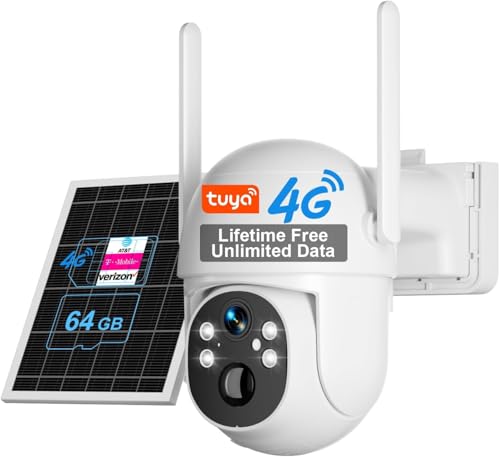
The SANSCO model emphasizes a truly off-grid setup with solar power and a built-in SIM that delivers lifetime unlimited data. It supports AT&T, T-Mobile, and Verizon in the U.S., and includes a 64GB microSD (TF) card for local storage with capacity for longer video retention. This camera is designed for remote locations like farms and campgrounds, delivering continuous monitoring with no ongoing monthly fees after initial activation and setup.
- 0 monthly fees; lifetime free unlimited data
- Built-in SIM compatible with major U.S. networks
- 7800mAh battery with upgraded solar panel
- Includes 64GB TF card (up to 128GB)
Vearoat 4G LTE Cellular Security Camera Outdoor System

The Vearoat system pairs a built-in SIM with 2K color night vision and a full 360° field of view. It highlights a long-term, data-free option with lifetime unlimited data and a 7800mAh battery plus a 7W solar panel. The camera supports PIR motion detection and real-time alerts, enabling proactive security in remote areas like farms or job sites.
- Zero monthly fees with lifetime data
- 7800mAh battery; 7W solar panel
- 2K color night vision; 360° pan/tilt
- PIR motion detection with alerts
MOES 4G LTE Cellular Solar Security Camera

The MOES camera combines 4G LTE connectivity with solar power and a built-in VSIM card to deliver lifetime data without monthly subscriptions. It captures 2K video for clear faces and details, and features AI-based PIR motion detection for efficient alerts. A 32GB storage option is included, with expansion potential for longer retention. This model is suitable for off-grid surveillance at construction sites, farms, or vacation homes.
- Lifetime free data; no subscriptions
- 7800mAh battery; solar-powered
- 2K video; AI PIR motion detection
- Includes VSIM card; 32GB storage (expandable)
HestiaGuard 4G LTE Solar Camera

The HestiaGuard camera is designed for off-grid security with 360-day unlimited data via a SIM plan. It features 3mp HD resolution with 360° PTZ and PIR motion detection. The device includes a 64GB microSD card with an option to expand storage, and it supports remote monitoring through a mobile app. It’s built for rugged outdoor use in remote properties, ensuring continuous coverage without a fixed internet connection.
- 360-day unlimited data SIM
- 3MP HD with 360° PTZ
- PIR motion detection; remote alerts
- Includes 64GB SD card; expandable storage
Buying Guide
Key purchase considerations help match a cellular camera to the site conditions and security goals. Start with power and connectivity: solar power is essential in remote locations, but ensure the solar panel and battery are sized for the climate and expected operation. Data plans matter: some cameras offer lifetime unlimited data, others require monthly subscriptions after an initial trial. Check network compatibility—the major U.S. networks (AT&T, Verizon, T-Mobile) are common, but roaming capabilities and SIM compatibility vary by model.
Video quality and coverage influence effectiveness. Look for 2K or 4K resolution and wide or pan/tilt capabilities to minimize blind spots. Night vision quality (color or monochrome) and infrared range determine effectiveness after dark. Motion detection should include PIR sensing to minimize false alerts, and features like auto-tracking can simplify monitoring across larger areas.
Storage options are important. Some cameras include microSD cards, others rely on cloud or local storage, or a combination. Verify whether cloud storage is included, optional, or perpetual, and consider environmental durability (IP rating), temperature range, and weather sealing for outdoor installs. Finally, assess ease of installation and app reliability, since intuitive controls reduce setup time and improve ongoing responsiveness.
From a security and value perspective, a mix of long data plans, solar reliability, and robust night vision provides the best overall coverage for off-grid sites. Compare device durability, lifetime data terms, and the ability to integrate with existing security ecosystems if needed. Breadth of rotation (pan/tilt) and alert customization are additional differentiators that help tailor a system to specific vulnerabilities, such as entry points or driveways.