Choosing a reliable bench power supply is essential for experimenting, prototyping, and testing electronics. This guide highlights five top options that balance voltage and current control, stability, safety features, and ease of use. Each model offers precise CV/CC modes, robust protection, and practical interfaces for hobbyists and professionals alike. Compare features, build quality, and charging efficiency to find the right fit for your workspace.
Summary Of Selected Products
| Product | Brand | Voltage Range | Current Range | |
|---|---|---|---|---|
| Jesverty SPS-3010 | Jesverty | 0-30V | 0-10A | 4-digit display, CV/CC auto-switch, USB port |
| Jesverty SPS-3010V | Jesverty | 0-32V | 0-10A | Coarse & Fine encoder, USB-C 20W, ON/OFF output |
| Kungber DC Power Supply | Kungber | 0-30V | 0-10A | Intelligent charging, OCP alarm, compact |
| Jesverty SPS-30II | Jesverty | 9-15V or 13.8V | Up to 30A | Screw terminals, cooling fan, compact footprint |
| BTECH RPS-30PRO | BTECH | 9-15V or 13.8V | Up to 30A | Noise offset, cigarette plug, multiple terminals |
Jesverty SPS-3010: 0-30V, 0-10A Bench Power Supply

The Jesverty SPS-3010 is a versatile bench supply designed for precision prototyping. It covers 0–30V and 0–10A, suitable for powering Arduino projects, sensor arrays, and test rigs. A standout feature is the 4-digit display that shows V, A, and W in real time with resolution up to 0.01V, 0.001A, and 0.1W. The device automatically transitions between constant-voltage (CV) and constant-current (CC) modes as load conditions change, helping protect sensitive circuits while ensuring stable operation. A 5V/2A USB port adds flexible charging for peripherals. The compact form factor makes it ideal for tight workbenches, with straightforward CV/CC adjustment for quick setup. The footnotes emphasize safe operation through proper setpoints and load awareness.
Performance notes: CV/CC auto-switch is driven by load current. The user-set V and A thresholds act as crossover points for mode switching, which can be advantageous for dynamic loads. As with any bench supply in this class, temperature and fan noise are considerations during heavy use. For users prioritizing a strong CV/CC response and USB charging capability, this model offers a balanced package.
Jesverty SPS-3010V: 0-32V, 0-10A with Encoder and USB-C

The SPS-3010V represents an upgrade with a 0–32V range and encoder coarse/fine adjustment for precise voltage settings down to 0.01V. The dual USB charging option includes USB-A and USB-C ports, providing up to 20W for rapid charging of mobile devices or microcontroller boards. An OUTPUT ON/OFF button simplifies testing, allowing changes without disconnecting the load. This model caters to users who need quick, repeatable voltage steps and efficient charging for peripheral devices, making it a practical choice for lab benches with several small projects running concurrently.
Considerations include ensuring your test load and wiring can handle brief transients during rapid changes. The dual USB ports are helpful for charging or powering connected devices, but total current should be allocated to both the load and charging duties. This model suits enthusiasts who value precision adjustment and convenient charging in one compact unit.
Kungber DC Power Supply: 0-30V, 0-10A With 18W USB

The Kungber DC Power Supply is a compact, feature-rich unit with a focus on intelligent charging and safety. It provides a 0–30V range and up to 10A, with an 18W USB port for quick charging of devices. Real-time display of charging power (Ah) supports battery or device monitoring, useful for educational labs and repair work. An overcurrent detection alarm (OCP) enhances safety by stopping output during faults, reducing risk when testing high-power circuits. The unit’s small housing makes it suitable for space-constrained benches, while it still offers robust protection features for routine lab use.
Users should note the balance between USB output and load current: if you draw high current from the load, USB charging capacity may be limited. The Kungber model is best for projects requiring a compact supply with reliable protection and handy charge capabilities for peripheral devices.
Jesverty SPS-30II: 9-15V/13.8V, 30A Bench Power Supply

The SPS-30II is a compact, high-current bench supply designed for radios, lab tests, and educational demonstrations. It can operate in fixed 13.8V or adjustable 9–15V ranges, providing reliable power for CB and HAM radio setups, among other uses. The screw-type terminals ensure universal compatibility with test leads and cables, while the compact footprint makes it easy to place near equipment racks or workstations. This model targets power users who require higher current for transmission equipment or high-load prototypes within a tight space, without sacrificing control or safety features.
Potential drawbacks include higher current capability requiring careful heat management and wiring considerations. The front terminals simplify connections, and its flexibility in voltage output makes it a strong choice for hobbyists and professionals who frequently switch between 13.8V and other voltage needs.
BTECH RPS-30PRO: 13.8V (9–15V) 30A, Noise Offset
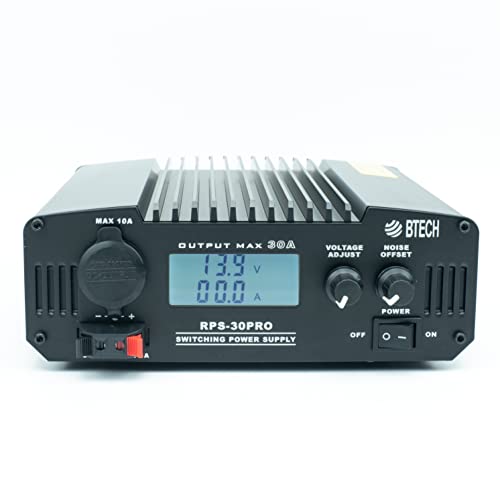
The BTECH RPS-30PRO provides robust DC power with a wide 9–15V adjustable range and up to 30A current. It offers a noise offset adjustment to minimize switching noise in sensitive audio or RF experiments. The unit includes multiple power connections, including cigarette lighter plug and snap-in terminals, enabling flexible wiring for a variety of devices. This model is well-suited for users who need a strong, reliable supply with practical connectivity options for lab benches, radios, and test racks. The noise offset feature can be particularly valuable for projects sensitive to voltage ripple.
As with high-current supplies, thermal management and ventilation are important. The RPS-30PRO delivers substantial current, so ensure adequate heat dissipation and safe wiring practices during heavy use or continuous operation.
Buying Guide: Key Considerations For Bench Power Supplies
- Voltage and current range: Match the supply to your typical project needs. Wider ranges offer more flexibility, but ensure the unit can safely deliver peak currents your devices require.
- CV/CC behavior: A supply that smoothly transitions between constant-voltage and constant-current modes protects sensitive devices during startup and variable loads. Look for auto-switching and clear indicators.
- Display and controls: Four-digit displays with high resolution help monitor real-time outputs. Coarse/fine knobs or encoders improve precision and speed when dialing in voltages.
- Protection: Overcurrent, short-circuit, and reverse-polarity protections are essential. Some models include OCP alarms or automatic shutdown to prevent damage.
- Connectivity: USB, USB-C, or dual USB ports can be convenient for charging peripherals or powering microcontrollers. Ensure the total current budget aligns with both load and charging needs.
- Terminals and wiring: Screw terminals and banana plug interfaces provide reliable, durable connections. Consider whether you need cigarette lighter sockets for quick accessory power.
- Thermal management: Cooling fans and chassis design affect performance under load. For high-current use, ensure adequate airflow and ventilation.
- Size and portability: Compact models save bench space but may sacrifice some capabilities. Choose based on the balance between footprint and required features.
Additional Perspectives
When selecting a bench power supply, consider your primary use cases: hobbyist experimentation, electronics repair, radio equipment powering, or lab-grade testing. For delicate electronics, a supply with precise voltage steps and low ripple is advantageous. For RF or audio projects, minimizing noise and ripple with a noise offset feature can improve test accuracy. If you frequently test multiple devices, a supply with multiple output ports or easy switching between fixed and adjustable modes can streamline workflows. Finally, assess service life, build quality, and vendor support to ensure long-term reliability in a home or professional workshop.