Starting with 3D printing can be smooth and productive with a model designed for beginners. The following picks emphasize automatic leveling, reliable pre-assembly, safe-operating features, and user-friendly interfaces to help newcomers achieve consistent results quickly. Each option is ready to print with minimal setup, supports beginner learning, and offers dependable performance for home, classroom, or small workshop use.
| Product | Brand | Print Area | Key Feature |
|---|---|---|---|
| FLASHFORGE Adventurer 5M | FLASHFORGE | 220x220x220 mm | Fully automatic bed leveling for flawless first layers |
| Geeetech M1 Mini | Geeetech | 3.94×4.33×3.94 in | Auto-leveling with direct drive for easy beginner use |
| Asani Mini Starter Kit | Asani | Compact footprint | Fully assembled starter kit with filament and SD card |
| ELEGOO Centauri Carbon | ELEGOO | 256x256x256 mm | Auto calibration and ready-to-print out of the box |
| XZN Fully Assembled Mini | XZN | Compact build area | All-in-one starter kit with auto leveling and fast setup |
Below are five carefully chosen models that balance ease of use, reliability, and value for beginner makers. Each section presents a quick overview, a visual, and key features to help you compare at a glance.
FlashForge Adventurer 5M: High-Speed Auto Leveling

The Adventurer 5M from FLASHFORGE is designed to appeal to beginners seeking convenience and speed. It features one-click automatic bed leveling, which helps ensure reliable first layers without manual tweaking. Its CoreXY architecture supports high-speed travel, enabling rapid prototyping while maintaining print quality. A detachable nozzle system and a direct extruder support flexible material handling, giving new users room to experiment with various filaments. The in-box setup is oriented toward straightforward, stress-free printing so learners can focus on design rather than calibration.
Operational notes for beginners: rely on the automatic bed leveling to minimize bed adhesion issues, and leverage the fast warm-up to move quickly from ideas to finished parts. The dual-sided build surface helps with easy model removal and repeatable prints. As a first-printer, Adventurer 5M emphasizes user-friendly workflows and accessible maintenance, making it a strong option for classrooms or home studios.
Geeetech M1 Mini: Auto-Leveling For Young Makers

The Geeetech M1 Mini focuses on simplicity and reliability, featuring auto-leveling and a straightforward plug-and-play experience. Its high-speed capabilities, up to 250 mm/s, enable quick iteration on school projects and home experiments. The direct-drive extruder with a robust gear train supports multiple materials, including flexible filaments, expanding beginner options beyond PLA. The device is compact enough for desks, shelves, or classroom corners, and the 16-point auto-leveling system reduces the setup complexity common in entry-level machines.
Why beginners may prefer this model: it combines a friendly control interface with a tolerant printing process, helping new users master basics like bed leveling, extrusion consistency, and print cooling. The user’s learning curve is flattened by a stable print bed and reliable feed system, making it easier to achieve repeatable results across different projects.
Asani Fully Assembled Mini Starter Kit

Asani’s Fully Assembled Mini 3D Printer is positioned as a complete starter kit for beginners. It ships with a fully assembled chassis, 10 meters of PLA filament, and an SD card with preloaded designs. This model emphasizes a compact footprint suitable for dorm rooms, classrooms, and small home offices. The kit approach reduces the need for extra purchases, and the platform is designed for easy model removal thanks to a flexible magnetic bed. Auto leveling and a simple 2.4-inch LCD provide approachable operation for new users who want quick, tangible results.
Key considerations for beginners: a complete starter kit reduces the total upfront cost and complexity. The included filament and designs help learners practice from day one, while the auto leveling and stable print bed promote consistent results without extensive calibration. This model is well-suited to schools or homes seeking a turnkey printing experience.
ELEGOO Centauri Carbon: Ready-To-Print CoreXY
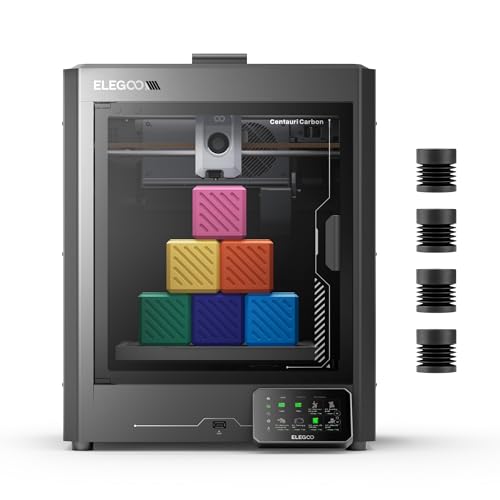
The ELEGOO Centauri Carbon is highlighted for its out-of-the-box readiness and high-speed capabilities. With auto bed leveling and a CoreXY structure capable of up to 500 mm/s, this printer is designed for users who want rapid build cycles without sacrificing print quality. A 320°C nozzle broadens material compatibility, enabling advanced filaments while the built-in camera helps monitor prints remotely. The cooling and enclosure features support more demanding projects and higher-temperature filaments, expanding what a beginner can responsibly attempt.
Ideal for learners who prefer an all-in-one device that minimizes manual setup, Centauri Carbon provides a balance of speed, ease, and potential for growth into more challenging projects. The ready-to-print experience is complemented by useful software controls and a clear interface, helping new users develop confidence as prints progress.
XZN Fully Assembled Mini Starter Kit

The XZN model is marketed as a fully assembled mini printer with an auto-leveling feature and a comprehensive starter kit. The package typically includes a roll of filament and an SD card to begin printing almost immediately after unboxing. It emphasizes a compact design, suitable for kids, classrooms, and small workspaces, while maintaining reliable print performance with a magnetic or flexible build surface for easy removal of models. The printer caters to beginners who want a straightforward path to learning the basics of 3D design and printing.
From a beginner’s perspective, this model offers a straightforward setup, minimal maintenance, and a predictable printing process. The included accessories and auto-leveling system help reduce common early-stage frustrations while building foundational skills in 3D modeling and physical prototyping.
Buying Guide: Key Purchase Considerations For Beginners
- Ease of use: Prioritize features like one-button auto-leveling, pre-assembled design, and intuitive interfaces to minimize setup time and troubleshooting.
- Print reliability: Look for stable beds, reliable extrusion systems, and protective enclosures or cooling that reduce warping and failed prints.
- Speed vs. quality: A printer with high-speed capabilities can reduce iteration time, but ensure it maintains print quality at typical beginner scales.
- Filament compatibility: Ensure support for common filaments such as PLA, PETG, and flexible materials if you plan to experiment beyond PLA.
- Build volume: Choose a size that fits your space while providing enough room for a variety of beginner projects.
- Customer support and resources: Access to tutorials, community forums, and responsive technical support helps new users overcome early hurdles.
- Software and connectivity: Consider models with straightforward software options and optional cloud or app control for remote monitoring.
- Safety and noise: Quiet operation and child-friendly safety features (enclosures, power management) are important in homes and classrooms.
- Expansion potential: Some printers offer upgrade paths (hotends, nozzles, build surfaces) to grow with your skills.
- Warranty and longevity: A solid warranty and durable components reduce total ownership costs and downtime.