The best backup battery power bank depends on what you need to keep running: a compact 20,000mAh model suits phone charging on the go, while a portable power station is better for higher-wattage devices and longer outages. The options below include everyday, solar-assisted, AA-battery-operated, and home-office backup choices. Compare their power source and intended use before buying; these products serve different needs and are not interchangeable.
| Product | Best For | Power Approach |
|---|---|---|
| TRKOY 20,000mAh Portable Charger | Fast phone and tablet top-ups | Rechargeable portable battery |
| Anker SOLIX C1000 Gen 2 | Emergency and off-grid power | Portable power station |
| Renogy 30W Solar Panel Charger | Outdoor charging in sunlight | Portable solar charging |
| 4 AA Battery Operated Phone Charger | Simple battery-powered backup | Replaceable AA batteries |
| CyberPower EC850LCD UPS | Desktop equipment backup | Plug-in UPS battery backup |
TRKOY 45W 20,000mAh Portable Charger

Best for: Commuters, students, and travelers who want a compact backup battery for compatible personal devices. Its listed 20,000mAh capacity, 45W output, and support for PD and QC make it the most straightforward everyday power-bank choice in this group.
The product description says its smart-recognition chip adjusts output for different devices and gives example charging estimates for select phones and a tablet. It also lists dimensions of 3.98 × 2.79 × 1.26 inches and says the capacity meets airline carry-on standards.
Limitation: Charging time and the number of charges vary by device and conditions. The provided information does not specify port count, so check the product listing if you need to charge multiple devices at once.
Anker SOLIX C1000 Gen 2 Power Station
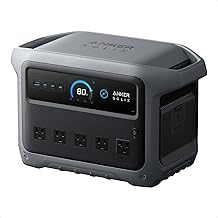
Best for: Buyers preparing for outages, camping, remote work, or off-grid use who need more capacity than a pocket-size phone bank provides. The listed capacity is 1,024Wh, with 2,000W output and 3,000W peak output across 10 ports.
Anker describes the unit as portable for moving between rooms, an RV, or outdoor locations. Its listing also states that HyperFlash recharging can fully recharge the station at 1,600W in 49 minutes when enabled in the Anker app. That makes it a better fit for broader backup needs than the smaller phone-focused options.
Limitation: This is a larger power station, not a pocket power bank. Confirm that the output and capacity suit the devices you plan to run; the listing does not mean every appliance will operate for the same length of time.
Renogy 30W Portable Solar Panel Charger

Best for: Outdoor users who want a solar-charging option for phones, tablets, or laptops, as identified in the product name. Its 30W rating distinguishes it from battery banks that must be recharged from an electrical outlet.
Choose this if access to sunlight is part of your backup plan, such as during camping or travel. It is a solar panel charger rather than a stated stored-energy battery bank, so it serves a different role from the TRKOY portable battery or Anker power station.
Limitation: The supplied product details do not specify charging ports, storage capacity, or charging speed. Solar output depends on available sunlight, so it should not be treated as a guaranteed source of power in every setting.
Four-AA Battery Phone Charger

Best for: Buyers who prefer a backup charger powered by four AA batteries and want an LED light included. Its replaceable-battery format may suit an emergency kit where keeping a precharged power bank ready is not convenient.
The product name identifies it as a phone charger with an LED light. It differs from rechargeable power banks because its stated power source is four AA batteries. Choose it if that battery format fits your preparedness plan.
Limitation: The supplied information does not state charging speed, phone compatibility, or how long the light runs. Check those details on the product listing before relying on it for a specific device or emergency duration.
CyberPower EC850LCD UPS Battery Backup

Best for: A desktop or home-office setup that needs battery-backed outlets and surge protection. This is a plug-in UPS, not a portable phone power bank. It has 12 NEMA 5-15R outlets: six with battery backup and surge protection, plus six surge-protected outlets, including three ECO-controlled outlets.
The multifunction LCD displays battery and power conditions. ECO mode can switch off power to connected peripherals when the UPS detects that a computer is off or asleep, helping reduce energy use.
Limitation: Only six of the 12 outlets are listed as battery-backup outlets. Check which equipment needs battery support and connect it to the appropriate outlets.
Buying Guide: How To Choose A Backup Battery Power Bank
What do you need to keep powered?
For a phone or tablet, consider a portable battery such as the 20,000mAh TRKOY model. For multiple devices or higher power needs, compare a power station’s watt-hour capacity, output, and port count with your equipment requirements. A desktop computer setup calls for a UPS with battery-backed outlets rather than a travel power bank.
Do you need stored power or power generation?
A conventional power bank stores energy for later use. A solar panel charger uses sunlight to provide charging and may be useful outdoors, but the supplied Renogy details do not list built-in storage. A solar panel and a battery bank can therefore serve complementary roles, but confirm product connections and requirements before planning a setup.
How should you compare capacity and output?
Capacity indicates how much energy a battery can store, while output affects which devices it can power and how quickly it can deliver energy. Compare watt-hours and watts for a power station, and check charging protocols and device-specific requirements for a portable charger. Actual runtime and charging totals vary with device demand and operating conditions.
Which backup source fits an emergency kit?
Consider how you will recharge or replenish the backup source. A rechargeable bank needs advance charging, an AA-powered charger needs compatible spare batteries, and a solar charger needs suitable light. A UPS is intended for equipment connected to household power and offers a different type of backup from travel-oriented products.
Frequently Asked Questions
What is the difference between a power bank and a UPS?
A power bank is a portable battery for charging personal devices. A UPS connects to powered equipment and provides battery backup through designated outlets when input power is interrupted.
Is a 20,000mAh power bank enough for travel?
It can suit travelers seeking phone and tablet backup, but the number of charges depends on the device, battery condition, and energy lost during conversion. Check airline rules and the product’s stated travel information before flying.
Can a solar panel charger replace a battery bank?
Not necessarily. A solar panel charger relies on sunlight, while a battery bank stores energy for use later. The supplied Renogy details do not state that it includes a battery.
Which option is best for a home computer?
The CyberPower EC850LCD is the option specifically described as a UPS with battery-backup outlets. Confirm that the computer and other essential equipment are connected to battery-backed outlets.
Should I choose a portable power station or a phone power bank?
Choose a phone power bank for compact personal-device charging. Choose a portable power station when you need more capacity, higher output, or support for several devices, after confirming its specifications match your equipment.