The best AV receiver or amplifier depends on whether you need HDMI-based home theater, multichannel surround sound, or a straightforward stereo setup. The Denon AVR-S570BT is best for newer 8K and gaming-focused systems, while the Yamaha RX-V6A suits buyers seeking wireless and multi-room options. Sony offers a simpler 5.2-channel home theater choice, and Donner models add useful microphone and audio-input options for karaoke or speaker setups.
| Product | Best For | Standout Features |
|---|---|---|
| Denon AVR-S570BT | 8K home theater and gaming | 8K HDMI inputs, eARC, Bluetooth |
| Yamaha RX-V6A | Wireless and multi-room audio | Wi-Fi, AirPlay 2, MusicCast |
| Sony STRDH590 | Simple 5.2-channel theater | 4K HDR pass-through, virtual surround |
| Donner MAMP4 5.1 | Surround sound with microphones | 5.1 channels, optical and coaxial |
| Donner 4-Channel Amplifier | Multi-speaker and karaoke setups | Four channels, two mic inputs |
Denon AVR-S570BT 5.2-Channel AV Receiver

Best for: Buyers building a home theater around 8K video sources, modern gaming features, and 5.1 surround sound. This receiver lists four HDMI 2.1 8K inputs, one HDMI output, and eARC. It supports HDR formats including Dolby Vision, HDR10+, and HLG, along with VRR and QFT for gaming.
The AVR-S570BT also supports Dolby TrueHD and DTS-HD Master audio and includes Bluetooth for wireless music streaming. Its listed output is 70 watts per channel across five channels. Choose it if HDMI connectivity and video-format support are priorities alongside surround sound.
Limitation: It is a 5.2-channel model, so buyers planning a larger-channel system should compare other options. The listed wireless feature is Bluetooth; Wi-Fi is not specified.
Yamaha RX-V6A 7.2-Channel Receiver

Best for: Buyers who want a 7.2-channel receiver with several wireless listening options. The RX-V6A lists Wi-Fi, Bluetooth, AirPlay 2, Spotify Connect, voice control, and MusicCast multi-room support. These features make it a better fit than a basic Bluetooth-only receiver for households that use networked music services or want audio in multiple rooms.
Its listed HDMI connections include seven inputs and one output, with eARC and HDCP 2.3. The product information also identifies 4K60, 4K120AB, and 8K60B HDMI 2.1 support. Choose this model if those connection formats and wireless services match your equipment and listening habits.
Limitation: The supplied feature information does not specify amplifier power. Check your speaker requirements and desired output before choosing it.
Sony STRDH590 5.2-Channel Receiver

Best for: Viewers seeking a relatively straightforward home theater receiver with 4K HDR pass-through and a virtual surround option. Sony’s S-Force PRO feature creates virtual front surround sound using a two-speaker setup, while the receiver is also described as a 5.2-channel model. Bluetooth is included for wireless audio playback.
The listed 4K pass-through supports HDR and HDCP 2.2, helping connect compatible video sources to a television. This Sony is a practical comparison for buyers who want home theater features without making wireless multi-room audio the main requirement.
Limitation: The virtual front surround feature is designed for a two-speaker setup; it is not the same as installing separate surround speakers. Confirm your preferred speaker arrangement before buying.
Donner MAMP4 5.1-Channel Amplifier
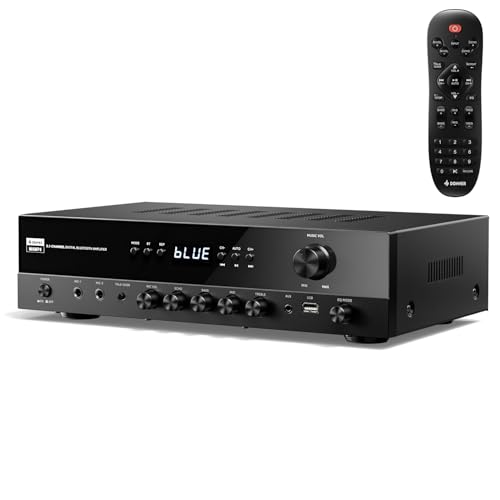
Best for: Buyers who want a 5.1-channel amplifier with microphone inputs and several non-HDMI connection options. Donner lists support for five speakers and one subwoofer, Bluetooth 5.3, USB, FM radio, AUX, RCA, AC-3, optical, and coaxial inputs. Two microphone inputs and echo and talkover controls make it a more karaoke-oriented choice than the Denon or Sony.
The listed RMS output is 60 watts for the left and right channels at 4 ohms, plus 25 watts each for the center and surround channels. The product description also notes that relays were added to reduce standby noise.
Limitation: This model has no HDMI input. Choose it only if its listed audio connections work with your TV and other sources.
Donner 4-Channel Home Audio Amplifier

Best for: Buyers who want to control multiple speaker groups or connect microphones for karaoke. Donner specifies four independently controlled channels and support for up to four groups of eight speakers at 4 to 8 ohms. Its connections include Bluetooth 5.3, USB, two pairs of RCA inputs, AUX, FM radio, optical, coaxial, and two microphone inputs.
The listed power is 25 watts RMS per channel, with 1000 watts described as peak power. Treble, midrange, bass, echo, and talkover settings are available through the remote. This amplifier offers more channel flexibility than the listed 5.1 Donner model, but it serves a different speaker configuration.
Limitation: The product listing explicitly says it has no HDMI input. It also advises turning the unit off using its front-panel power control to avoid humming noise.
Buying Guide: How To Choose An AV Receiver Or Amplifier
Do you need HDMI for a TV or gaming system?
Choose a receiver with HDMI inputs if you want video sources routed through the receiver. Compare the listed HDMI version, resolution support, and eARC availability with your TV and source devices. Denon lists HDMI 2.1 8K inputs and eARC; Sony lists 4K HDR pass-through. The Donner amplifiers described here do not include HDMI, so their optical, coaxial, or other audio connections need to suit your setup.
How many channels do your speakers need?
Match the receiver’s channel count to the speaker layout you plan to use. A 5.1 or 5.2 system is a common home theater configuration, while a 7.2-channel receiver offers more channel capacity. A four-channel amplifier is intended for a different type of multi-speaker setup. Check whether the product listing specifies subwoofer support and speaker impedance.
Which wireless features matter?
Bluetooth supports wireless playback from compatible devices. Wi-Fi, AirPlay 2, Spotify Connect, and multi-room features can be useful when you want network-based streaming or linked rooms. Compare the exact services listed for each model rather than assuming all receivers offer the same wireless options.
Do you need microphone inputs?
For karaoke or announcements, check for microphone inputs and controls such as echo or talkover. The Donner models in this comparison list two microphone inputs. The Denon, Yamaha, and Sony feature descriptions emphasize home theater or music playback rather than microphone functions.
Frequently Asked Questions
What is the difference between an AV receiver and an amplifier?
An AV receiver combines amplification with input switching and, in many models, video connections and surround sound processing. An amplifier primarily boosts audio signals, though feature sets vary by product.
Can I connect a TV to an amplifier without HDMI?
Possibly, if the TV and amplifier share a supported audio connection, such as optical or coaxial. Check both devices’ outputs and inputs, and select the correct TV audio-output setting if required.
Is a 5.2-channel receiver the same as a 5.1-channel receiver?
Both describe five main speaker channels. The “.2” indicates support for two subwoofer outputs or connections as specified by the receiver; it does not mean two additional surround speakers.
Should I choose Bluetooth or Wi-Fi streaming?
Bluetooth is useful for direct playback from a nearby paired device. Wi-Fi-based features can support network streaming and services such as Spotify Connect when listed by the receiver.
What should I check before connecting speakers?
Compare the receiver’s channel layout, speaker impedance requirements, and output specifications with your speakers. Also confirm that your TV and source devices have compatible audio or HDMI connections.