The best AC/DC amp clamp meter depends on the measurements and work area you need to handle. The KAIWEETS meter suits buyers seeking a broad set of functions, while the Fluke 301D/ESP is designed for tight spaces. AstroAI offers useful display and data-hold features, Klein Tools CL390 adds temperature and DC microamp measurements, and FKM lists a 600-amp range with a backlit display and flashlight.
| Meter | Best For | Listed Highlights |
|---|---|---|
| KAIWEETS Digital Clamp Meter | Multi-function troubleshooting | D-shaped jaw, temperature, NCV |
| Fluke 301D/ESP | Tight work areas | Slim body, thin jaw |
| AstroAI Digital Clamp Meter | Feature-rich everyday checks | Data hold, Max/Min, backlight |
| Klein Tools CL390 | Broader test-lead measurements | Temperature, DC microamps, TRMS |
| FKM 600 Amp Clamp Meter | Low-light troubleshooting | 6000 counts, flashlight, thermocouple |
KAIWEETS Digital Clamp Meter

Best for: Buyers who want current measurements alongside a wide range of electrical tests. The listed functions include AC/DC current and voltage, temperature, capacitance, frequency, resistance, continuity, diode testing, and non-contact voltage detection.
The meter has a D-shaped jaw that opens up to 1.1 inches. Its NCV feature uses audible and visual alerts to indicate detected AC voltage without direct circuit contact. The feature list also identifies it as a True-RMS meter, which may be useful when selecting a meter for varied troubleshooting tasks.
Consider: The clamp opening is limited to the listed 1.1 inches. Check cable size and the measurement method needed before choosing it.
Fluke 301D/ESP Clamp Meter

Best for: Electricians and maintenance workers who need a slim clamp for restricted access. The listed jaw is 10 millimeters thick, and the product description highlights its slim body and thin jaw arm for reaching into tight spaces.
The listing specifies AC current measurements up to 600 amps and a CAT III 300V safety rating for common residential and commercial settings. Although the product name describes it as an AC/DC clamp meter, the provided feature details specify AC current only. Confirm the current-measurement capability needed for your work before purchasing.
Consider: The supplied specifications do not describe DC current measurement details or a broader set of multimeter functions.
AstroAI Digital Clamp Meter
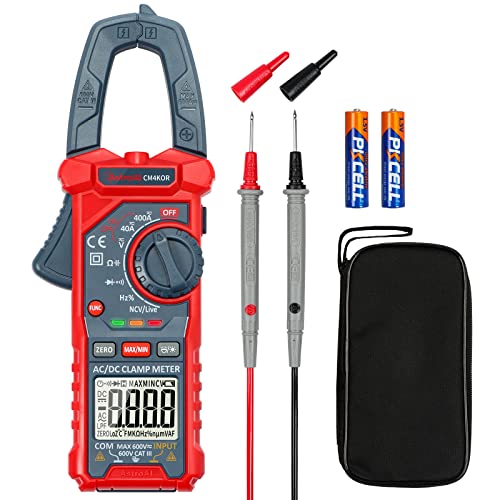
Best for: Buyers who want measurement options and reading-management features in one meter. The listed functions include AC/DC current and voltage, capacitance, frequency, duty cycle, resistance, diode, continuity, and live-wire testing.
For practical use, the AstroAI includes data hold, Max/Min readings, a backlit LCD, and a flashlight. Its NCV detection uses sound and light alerts, while a zero function is listed to reduce data error influenced by Earth’s magnetic field. Auto power-off and a low-battery indicator are also included in the feature description.
Consider: Its listed current range is not specified in the supplied product details, so verify that it suits the amperage you expect to measure.
Klein Tools CL390 Clamp Meter
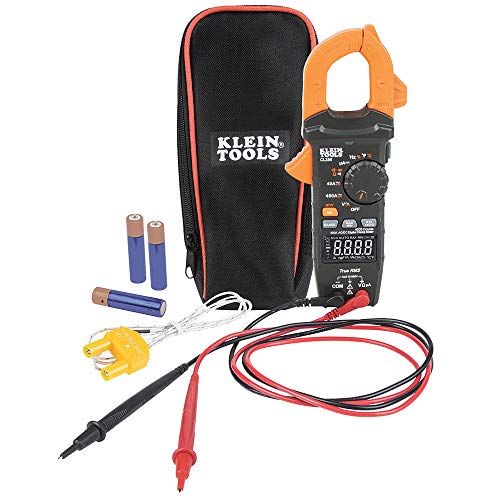
Best for: Users who need AC/DC current measurements plus specialized test-lead functions. The CL390 measures AC/DC current and NCVT through the clamp, while its test leads support AC/DC voltage, resistance, continuity, frequency and duty cycle, DC microamps, diode testing, and capacitance.
The listed package of functions also includes temperature measurement with a thermocouple. A reverse-contrast display is designed to improve visibility in different lighting conditions. This makes the CL390 a strong option for buyers comparing meters by measurement coverage rather than just current capacity.
Consider: Several listed measurements, including voltage and resistance, require test leads rather than the clamp jaw.
FKM 600 Amp Clamp Meter

Best for: Buyers seeking a True-RMS clamp meter with a stated 600-amp AC/DC current capability and extra low-light aids. The feature list includes 6000 counts, AC/DC voltage, resistance, capacitance, diode, continuity, frequency, temperature with a thermocouple, live/zero-wire discrimination, and NCV.
The listing states that the jaw measures current only, with a maximum wire diameter of 1.02 inches. It also advises clamping one wire—not an entire power cord—and centering that wire in the clamp. A backlit screen and LED flashlight are included for dim work areas.
Consider: Do not use the jaw to measure voltage; follow the stated distinction between clamp-current measurements and other measurement methods.
Buying Guide: How to Choose an AC/DC Clamp Meter
Do you need AC, DC, or both?
Check the exact current types listed in the specifications. Some meters measure AC and DC current through the clamp; others may list only AC current in the detailed features. Do not rely on a product title alone when DC current measurement is essential.
What measurements do you need beyond current?
Compare voltage, resistance, continuity, capacitance, frequency, diode, and temperature functions against your tasks. Also check whether each measurement uses the clamp or test leads. A broader function list can reduce the need for separate tools, but only if it matches the work you perform.
Will the jaw fit the cable?
Compare jaw opening or thickness with the conductors you expect to measure. For a current reading, clamp around a single conductor unless the meter instructions specify otherwise. Clamping an entire cable containing both outgoing and return conductors may not provide the intended reading.
Which display and safety details matter?
Backlighting, a flashlight, display contrast, data hold, and NCV alerts can help with visibility and workflow. Check stated safety ratings and measurement limits for the specific electrical environment. Follow the meter’s instructions and use appropriate electrical safety practices.
Frequently Asked Questions
What does an AC/DC clamp meter measure?
It measures current by clamping around a conductor, and many models also measure voltage and other electrical properties. The exact functions vary by product.
Can a clamp meter measure current without disconnecting a wire?
Clamp-style current measurement is designed to read current around an individual conductor without placing the meter in series. Follow the product instructions and use safe working practices.
Can I clamp around an entire power cord?
For the FKM meter, the supplied instructions say to clamp one wire, not the whole power cord. Check the instructions for your specific meter and measurement.
Is NCV the same as measuring voltage with test leads?
No. NCV detects voltage without direct electrical contact, while test-lead voltage measurement uses probes and provides a meter reading. Use the appropriate method for the task.
Why check the jaw opening before buying?
The jaw must fit around the conductor being measured. Compare its specified opening with the cable size and available access in your work area.