The best 4-channel amplifier for 4-ohm speakers depends on the power each channel provides, installation space, and whether you need marine-oriented features or flexible system tuning. The Recoil DI550.4 is a clear match for 4-ohm speaker setups, while the Pioneer GM-A6704 offers a 4-ohm RMS rating and bridged operation. The SounDigital model suits compact installations; the Taramps is better for systems wired to its stated 2-ohm channel load; and the Pyle is designed for marine use, though its listed features do not specify a 4-ohm power rating.
| Amplifier | Best suited for | Listed 4-ohm information |
|---|---|---|
| Recoil DI550.4 | Flexible car-audio systems | 80 watts RMS per channel |
| Pioneer GM-A6704 | Four speakers or bridged setup | 60 watts RMS per channel |
| SounDigital 800.4 EVO 4.0 | Compact installations | Product name specifies 4 ohms; per-channel rating is not provided |
| Taramps TS 1200 | Higher-output systems wired to its specifications | 600 watts RMS bridged at 4 ohms |
| Pyle Hydra PLMRA402 | Marine audio installations | Listed features do not specify a 4-ohm rating |
Recoil DI550.4 Full-Range Class-D Amplifier

Best for: Car-audio buyers who want a stated power rating for 4-ohm speakers and useful adjustment controls. The Recoil provides 80 watts RMS per channel at 4 ohms, making it the most directly documented match in this group for four 4-ohm speaker loads.
It also lists 130 watts RMS per channel at 2 ohms and 260 watts RMS per channel when bridged at 4 ohms. Gain, low-pass filter, high-pass filter, crossover, and bass EQ controls support different system configurations. Its Class D design, MOSFET power supply, and four-way protection circuitry are included among the listed features.
Limitation: Check the speaker and bridged-load requirements before wiring. The maximum power figure is not the same as the RMS output rating.
Pioneer GM-A6704 Class AB Amplifier

Best for: Buyers seeking a four-channel amplifier with a clearly stated 4-ohm output and the option to bridge channels. Pioneer lists 60 watts RMS per channel at 4 ohms, or 190 watts RMS by two channels when bridged. This makes it a straightforward comparison choice for four speakers or a compatible bridged configuration.
The Class AB design is described as balancing efficiency and performance. The amplifier can be used to balance front and rear audio and, in a suitable system configuration, add a subwoofer.
Limitation: The listed 1,000-watt figure is maximum power, not the 4-ohm RMS rating. Use the RMS figures when matching an amplifier to speakers.
SounDigital 800.4 EVO 4.0 Compact Amplifier

Best for: Buyers working with limited installation space, including compact vehicles and motorcycle audio builds. The product details emphasize its small footprint and describe use with door speakers, mids, tweeters, or a bridged subwoofer. Its conformal-coated components are presented as moisture- and vibration-resistant, which may suit installations exposed to rough conditions.
The product name specifies 800 watts RMS and a 4-ohm configuration, but the supplied feature information does not break down its per-channel 4-ohm output. Confirm the exact output and wiring requirements for your intended setup before purchase.
Limitation: Buyers who need a clearly stated per-channel 4-ohm RMS figure should compare the published specifications carefully.
Taramps TS 1200 Four-Channel Amplifier
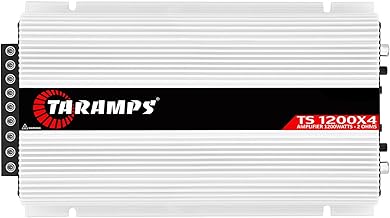
Best for: Buyers building a higher-output system who can match their wiring to the amplifier’s stated load ratings. Taramps lists 4 × 300 watts RMS at 2 ohms and 2 × 600 watts RMS when bridged at 4 ohms. It also provides RCA and high-level inputs, plus high-pass, low-pass, and full-range modes.
High-level inputs with automatic turn-on are intended to connect to an original-equipment stereo without an adapter. That can be useful when the vehicle’s factory radio is staying in place.
Limitation: The listed four-channel rating is at 2 ohms, not 4 ohms. Do not assume the same output at 4 ohms; verify the manufacturer’s full specifications and have installation performed by a qualified professional if needed.
Pyle Hydra PLMRA402 Marine Amplifier

Best for: Buyers prioritizing a marine-oriented four-channel amplifier. Pyle describes this model as a marine amplifier with RCA stereo inputs and high-level terminal inputs for receivers without RCA outputs. Its listed protections include thermal overload and speaker-short protection, and it has an aluminum-alloy heatsink and LED indicator.
Limitation: The provided features do not state a 4-ohm RMS rating or an IP-01 rating’s specific test details. Confirm speaker impedance compatibility and environmental requirements before choosing it for a particular installation.
Buying Guide: Choosing A 4-Ohm Four-Channel Amplifier
How much RMS power do your speakers need?
Compare an amplifier’s RMS output at 4 ohms with each speaker’s recommended power range. RMS is more useful for matching than a maximum or peak wattage figure. Of these options, Recoil lists 80 watts RMS per channel at 4 ohms, and Pioneer lists 60 watts RMS per channel at 4 ohms.
Are all four channels rated at 4 ohms?
Check the rating for the exact configuration you plan to use. The Taramps listing gives its four-channel output at 2 ohms and its 4-ohm figure for bridged operation. Do not treat a bridged 4-ohm rating as a rating for four separate 4-ohm channels.
Will you use the factory stereo?
If the factory radio has no RCA outputs, high-level inputs may be useful. Taramps and Pyle list high-level input options. Confirm the input and turn-on method against your vehicle’s audio system before buying.
Where will the amplifier be installed?
Measure the available mounting area and account for wiring and ventilation. SounDigital specifically emphasizes a compact footprint and moisture- and vibration-resistant components. For marine use, review the complete installation and environmental specifications rather than relying on a general product description.
Frequently Asked Questions
Can a four-channel amplifier power four 4-ohm speakers?
Yes, if its specifications support a 4-ohm load on each channel and its RMS output suits the speakers. Confirm the per-channel rating rather than relying only on total or maximum wattage.
Does a 4-ohm rating mean 4 ohms per channel?
Not necessarily. A product may state a 4-ohm rating only for bridged operation. Check whether the specification applies to each channel individually or to a bridged pair.
Is RMS or maximum power more useful for comparison?
RMS output is generally the more useful figure for matching an amplifier to speakers. Maximum-power claims do not indicate continuous output at a specific impedance.
Can I bridge a four-channel amplifier?
Some four-channel amplifiers support bridging, but the allowable speaker impedance and output vary by model. Follow the specific wiring and load instructions for the amplifier.