Finding an accurate and reliable 4 axis motion controller is essential for precise CNC router, milling, and engraving work. This guide highlights top 5 4-axis controllers and related kits, emphasizing standalone operation, USB/Mach3 compatibility, and support for servo and stepper motors. Each product is evaluated for ease of use, expandability, and integration with common CNC software and workflows. Use the buying guide at the end to compare features and choose the best fit for your project needs.
| Product | Brand | Axis Support | Key Benefit | Type |
|---|---|---|---|---|
| CNCTOPBAOS DDCSV3.1 4 Axis | CNCTOPBAOS | 4 | Standalone with high 500KHz per axis | Offline Controller |
| DWEII Mach3 USB Interface Board | DWEII | 4 | USB-based, highly compatible with notebooks/tablets | Motion Controller Card |
| CNCTOPBAOS DDCSV3.1 Offline Stand Alone | CNCTOPBAOS | 4 | G-code friendly, large TFT display | Offline PLC |
| CNCTOPBAOS DDCSV4.1 4 Axis | CNCTOPBAOS | 4 | 500KHz interpolation, Slave function for gantry | Offline Controller |
| RATTMMOTOR 4 Axis Kit | RATTMMOTOR | 4 | Included Mach3 control card and USB interface | Motor Kit & Controller |
CNCTOPBAOS DDCSV3.1 4 Axis Offline Controller

The DDCSV3.1 4-axis motion controller operates as a standalone system, eliminating the need for a computer during operation. It supports up to 500KHz per axis for high-precision control of both stepper and servo motors. Its 5-inch TFT screen with a 480×272 resolution provides an intuitive interface, while 16 digital inputs and 3 digital outputs enable complex control schemes. The device uses an ARM9 main control chip and an FPGA core algorithm, and it accepts G-code input via a 4G USB flash drive, with no size limit on G-code files. Jog functionality is available for each axis, and the system supports NPN-type limit switches. The built-in MPG handwheel with E-stop enhances manual control and safety during setup and operation.
Key specifications and features include:
- Highest output pulse per axis: 500KHz
- Standalone operation, no computer required
- 5″ TFT display, 480×272 resolution
- G-code input via USB drive; unlimited file size
- 16 digital inputs, 3 digital outputs; analog spindle control 0-10V (PWM capable)
- Jog per axis with defined distances; supports FANUC-style G-code
DWEII Mach3 USB Interface Board

The DWEII Mach3 USB Interface Board is designed to optimize Mach3 motion control for four axes, with a maximum step-pulse frequency of 100 kHz suitable for both servo and stepper motors. It emphasizes portability and simple configuration, making it a practical choice for laptops and tablets used for CNC control. Note that newer product iterations may ship without a CD; the manual is available via a QR code for easy access. The board includes four general-purpose isolated relay outputs, enabling spindle start/stop control, forward/reverse rotation, and pumps, among other functions.
Highlights include:
- USB-based Mach3 motion control card for laptops and tablets
- 100 kHz maximum step-pulse frequency per axis
- Four isolated relay outputs for spindle and auxiliary devices
- Evaluate compatibility with your current software setup via Mach3
CNCTOPBAOS DDCSV3.1 Offline 4 Axis Controller

This CNCTOPBAOS DDCSV3.1 model provides offline stand-alone control for four axes and emphasizes compatibility with G-code sets through a user-friendly 5″ TFT screen. The system supports an analog spindle control 0-10V and can be configured to output PWM signals. It features an ARM9 main control chip and an FPGA-based core, which helps deliver reliable performance for CNC routers, lathes, and engraving machines. It also includes a jog function for precise axis movements and supports NPN limit switches.
Key points include:
- 4-axis standalone operation with G-code input
- 5″ display, 480×272 resolution
- Analog spindle control and PWM output options
- 16 digital inputs, 3 digital outputs
- Jog function and customizable travel distances
CNCTOPBAOS DDCSV4.1 4 Axis Offline Controller
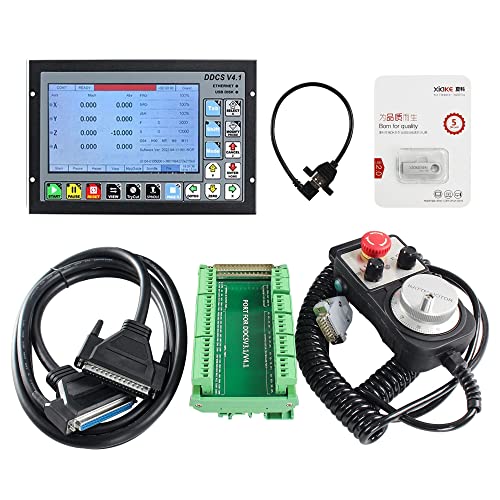
The DDCSV4.1 model expands to 4 axes with a larger 7-inch TFT screen, offering a 1024×600 resolution and dual 17-key operation. It supports differential and double-pulse output modes, with a maximum interpolation pulse frequency of 500 kHz per axis. This controller supports 2-4 axis linear interpolation and any 2-axis circular interpolation. It uses an ARM9 main control chip and an FPGA core, with 18 digital inputs and 3 digital outputs. A slave function supports gantry machines with independent motors on main axes, enabling more complex configurations.
Key considerations include:
- Large 7″ display for easier setup
- High 500 kHz per axis interpolation
- Multiple interpolation modes for complex geometry
- Slave function suitable for gantry setups
RATTMMOTOR 4 Axis Nema 23 Kit
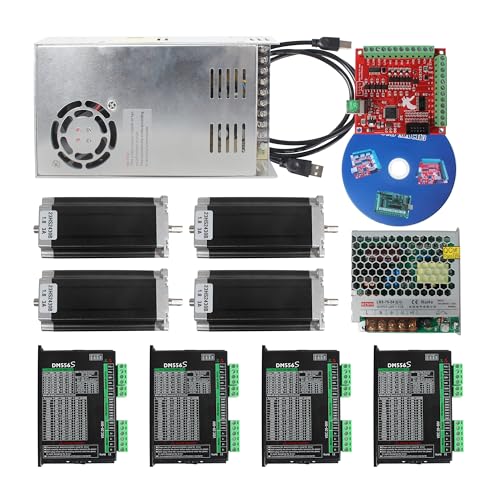
This kit includes four Nema 23 stepper motors (425 oz-in torque), a DM556S driver, and a USB Mach3-compatible control board. The motors are rated for 3 A with a holding torque of 425 oz-in, combining strong torque with compact dimensions. The DM556S driver supports extensive microstepping, with an input voltage range of 20-50 V DC and broad compatibility with Mach3 via USB, eliminating driver installation requirements on most systems. The package is designed for CNC router and engraving machine setups, with simple wiring diagrams provided for quick integration.
Core features include:
- 4x Nema 23 stepper motors (425 oz-in)
- DM556S driver with microstep capability
- USB Mach3 control board for broad PC compatibility
- Standard 24V-50V DC power compatibility
RATTMMOTOR CNC Controller Kit (4 Axis)
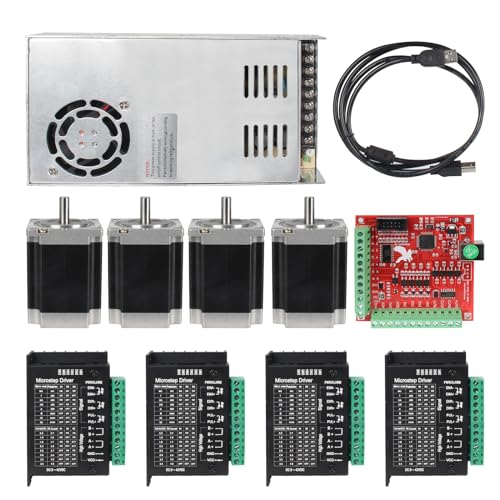
This kit combines four-axis control with Nema 23 stepper motors and a TB6600 driver, paired with a USB Mach3 CNC motion control card and a 24V power supply. The wiring diagrams detail how to connect stepper motor wires to the TB6600 drivers, ensuring straightforward installation. The kit is designed for builders who want a compact, USB-driven solution that can run standard Mach3 software without requiring complex driver configurations. It supports a wide range of PC hardware, provided Mach3 can be executed on the host system.
Key specifications include:
- 4-axis Mach3-compatible control with USB
- TB6600 driver with 3-4 A range for robust torque
- Detailed wiring guidance for easy setup
- Compatible with 24V power supply for reliable performance
Buying Guide: Key Purchase Considerations
When selecting a 4 axis motion controller system, consider the following aspects to ensure the option matches your CNC requirements:
- Standalone vs. PC-connected: Standalone controllers can run without a computer, reducing setup complexity and potential software conflicts. PC-connected solutions may offer broader software compatibility and easier updates.
- Pulse rate and interpolation: Higher pulse rates (up to 500 KHz per axis on several models) enable smoother motion and finer resolution, especially for high-speed engraving or milling. Evaluate whether 2D/3D interpolation and circular interpolation meet your geometry needs.
- Control interface: A larger TFT display improves usability during setup. Look for jog functions, defined travel distances, and user-friendly menus to minimize training time.
- Spindle control: Analog 0-10V spindle control is useful for variable-speed operations. PWM output support can broaden compatibility with spindle drivers.
- Input/Output options: Number and type of digital inputs/outputs matter for limit switches, relays, and spindle control. Ensure there are enough isolated inputs/outputs for your safety and automation needs.
- Compatibility with Mach3 and G-code: If you rely on Mach3 or specific G-code configurations, verify that the controller supports your preferred version and file input methods (USB drive vs. direct USB/MAC).
- Wiring and documentation: Clear wiring diagrams and manuals reduce installation time. Some kits provide QR-coded manuals, which can be convenient for quick reference on the shop floor.
- Expansion and futureproofing: If you plan to add more axes or larger machines (gantry configurations), consider slave or multi-axis support features and the ability to handle two independent motors on a main axis.
Across these options, buyers should balance standalone reliability, software compatibility, and physical integration with existing machines. For hobbyists and small shops, turnkey kits with included motors and clear wiring guides can accelerate setup. For advanced users, controllers offering higher pulse rates and flexible interpolation modes provide greater motion quality for demanding tasks.