Finding the right 32 GB server memory can boost reliability, reduce latency, and improve throughput for demanding workloads. Below is a curated guide to five solid 32 GB RAM kits designed for servers and workstations. Each entry highlights compatibility notes, speed, and memory type to help you choose the best option for your system.
| Product | Memory Type | Speed | Capacity | Form Factor |
|---|---|---|---|---|
| Timetec Hynix Original 32GB Kit | RDIMM ECC | 3200MHz | 32GB (2x16GB) | 288-pin |
| A-Tech 32GB Kit (2x16GB) DDR4 2133MHz | LRDIMM ECC | 2133MHz | 32GB (2x16GB) | 288-pin |
| A-Tech Server 32GB Kit (2x16GB) DDR4 2133MHz | UDIMM ECC | 2133MHz | 32GB (2x16GB) | 288-pin |
| Timetec 32GB Kit (2x16GB) DDR4 2666MHz | UDIMM Non-ECC | 2666MHz | 32GB (2x16GB) | 288-pin |
| Timetec Hynix Original 32GB DDR4 2666MHz | RDIMM ECC | 2666MHz | 32GB | 288-pin |
Timetec Hynix Original 32GB Kit (2x16GB) DDR4 3200MHz
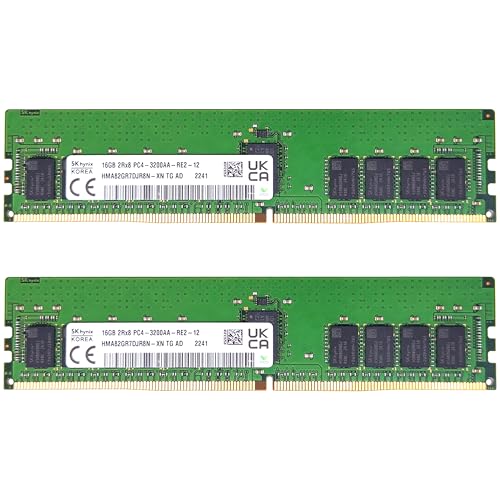
Timetec’s 32GB kit uses DDR4 3200MHz registered ECC RAM, designed for server environments. It features a 2x16GB configuration in a 288-pin RDIMM form factor, with VDD and VDDQ operating around 1.2V. This kit is advertised as a must-have for servers and is not intended for desktop or laptop systems. ECC support helps protect against data errors, essential in critical server workloads.
A-Tech 32GB Kit (2x16GB) DDR4 2133MHz ECC LRDIMM

This 32GB RAM kit uses Load-Reduced DIMM (LRDIMM) technology with ECC, aimed at select servers. It is a 2x16GB kit rated up to 2133MHz and 1.2V, with a 288-pin, dual rank (2Rx4) configuration. It’s clearly labeled for server use and is not compatible with most desktops or laptops. If your system supports LRDIMM and you need higher stability for memory-intensive operations, this option is worth considering.
A-Tech Server 32GB Kit (2x16GB) DDR4 2133MHz ECC UDIMM

This kit provides ECC memory in a UDIMM 288-pin form factor, suitable for server/ workstation boards that require unbuffered ECC memory. It runs at 2133MHz and is specified as compatible with select DDR4 servers/workstations. As with other server-grade RAM, verify your motherboard’s support for UDIMM ECC before purchase.
Timetec 32GB DDR4 2666MHz RDIMM Registered ECC

Timetec’s 32GB registered ECC RDIMM runs at 2666MHz and is designed for server environments. With a 2Rx4 dual-rank configuration, it provides robust ECC protection and stable operation under server workloads. The module is intended for servers, not typical desktop or laptop PCs, and adheres to JEDEC DDR4 standards at 1.2V.
Timetec Hynix Original 32GB DDR4 2666MHz
This Timetec module features DDR4 2666MHz speed with registered ECC in a 32GB RDIMM configuration. It is specified as a server memory option and emphasizes compatibility with enterprise-grade boards. It uses a 2Rx4 layout and 1.2V power, offering ECC protection for critical server operations.
Buying Guide
Key considerations when selecting 32 GB server memory:
- Memory type and compatibility: RDIMM, LRDIMM, and UDIMM each target different server architectures. Check your motherboard or server’s documentation for supported types, ranks, and memory channels.
- Speed and latency: Higher MHz can improve bandwidth, but ensure your system supports the rated speed. Also consider CL timings (lower is faster) in relation to your workload.
- Voltage and stability: Server RAM typically operates at 1.2V. Use memory with appropriate ECC features to protect against data errors in uptime-critical environments.
- Capacity per module vs. total capacity: 2x16GB is common for 32GB kits, but ensure your server supports the configured modules and ranks (2Rx4, 4Rx4, etc.).
- Buffering and registered status: RDIMM and LRDIMM are buffered and support larger server memory arrays; UDIMM is unbuffered and generally used in workstations or some servers that support it. Verify compatibility to avoid POST or boot issues.
- Server workload alignment: Databases, virtualization, and memory-intensive apps benefit from higher memory bandwidth and ECC protection. For less demanding tasks, a 2133MHz kit may suffice if you’re upgrading an older system.
- Future upgrade path: Consider leaving room for expansion or matching a second memory channel strategy to maximize performance without replacing existing modules.
In summary, choosing between ECC RDIMM, LRDIMM, or ECC UDIMM depends on your motherboard support and stability requirements. For critical workloads, ECC with registered memory (RDIMM/LRDIMM) is generally preferred due to error-checking capabilities. Always verify compatibility with your server’s hardware vendor guidelines before purchasing.