Choosing the right 2×2 video wall processor can dramatically improve how you present large, multi-screen content. This guide highlights five top-rated 2×2 wall processors available on Amazon, detailing key features, inputs and outputs, rotation and bezel options, and audio handling. Ideal for digital signage, control rooms, live events, or immersive retail displays, these devices let a single source drive four displays with flexible layouts and reliable control. Below you’ll find concise product sections, a quick summary, and essential buying considerations to help you compare performance and value.
Summary Table of Chosen Products
| Product | Brand | Key Feature Emphasis | Input / Output | Rotation / Bezel |
|---|---|---|---|---|
| Portta HDMl Video Wall Controller 2×2 4K | Portta | 11 display modes; 4K input; 180° rotate | 1x HDMI input → 4x HDMI outputs | 180° rotation; edge masking |
| OREI 4K 2×2 Video Wall Controller | OREI | Multiple modes; 4K up to 60 Hz; EDID management | Input: 2; Output: 4 | Bezel adjustments; EDID |
| Yuemona Video Wall Controller 2×2 4K | Yuemona | 4K 30 Hz outputs; audio options | HDMI/DVI input → 4 outputs | 180° rotation; edge masking |
| J-Tech Digital 4k 2×2 Video Wall Controller | J-Tech Digital | 8 display modes; audio extraction | HDMI in → 4 HDMI out | 180° rotation; edge masking |
| PORTTA 2×2 HDMI/USB-C Video Wall Controller | Portta | 11 display modes; 4K60Hz input | 1x HDMI/USB-C input → 4x outputs | 180° rotation; bezel adjustment |
Portta 2×2 HDMI Video Wall Controller 4K

Portta’s HDMI 2×2 video wall processor distributes one input to four outputs with 11 display modes, including 2×2, 1×2, 1×3, 1×4, 2×1, and PC portrait configurations. It supports 4K input at 30 Hz and 1080p outputs at 60 Hz. It also provides Toslink 5.1-channel audio extraction and 3.5 mm stereo output. Rotation and edge masking help minimize seams and maintain image continuity across the wall.
OREI 4K 2×2 Video Wall Controller

OREI’s wall processor delivers 2×2 splitting with 4K@60 Hz or 4K@30 Hz output options, configurable via multiple display modes (2×2, 1×2, 1×3, 1×4, 4×1, and more). It supports DSC-compatible HDMI outputs and a robust EDID management system to optimize bezel alignment and color accuracy. Audio can be routed through HDMI, SPDIF, or analog L/R, making it suitable for integrated AV setups in conference rooms and retail displays. HDR formats are not listed as supported.
Yuemona Video Wall Controller 2×2 4K
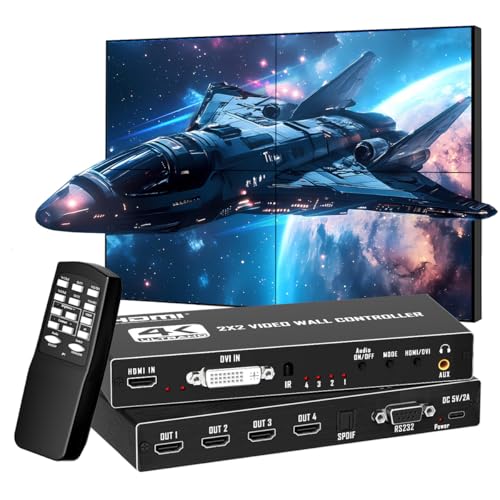
Yuemona’s 2×2 wall processor distributes a single HDMI or DVI input to four outputs and supports 4K at 30 Hz while providing 1080p outputs. It offers 180° screen rotation in the 2×2 mode and edge masking to reduce seam visibility. The unit includes 5.1-channel audio passthrough and a 3.5 mm audio output option, giving flexibility for combining with external sound systems in larger installations.
J-Tech Digital 4k 2×2 Video Wall Controller

J-Tech Digital’s wall processor supports 4K 60 Hz input and up to 4K 30 Hz on outputs, with eight display presets including 2×2, 1×2, 2×1, 1×3, 3×1, 1×4, 4×1, and a splitter mode. It emphasizes audio extraction via SPDIF and 3.5 mm outputs. The device is designed for seamless signal routing across four displays without noticeable delay, suitable for control rooms or live production backdrops where audio integration matters.
Portta 2×2 HDMI or USB-C Video Wall Controller

Portta’s second model combines HDMI or USB-C input with four HDMI outputs, offering 11 display modes and 4K60 Hz input support with 1080p 60 Hz or lower scaling for outputs. It includes 180° rotation and 8-pixel bezel adjustment to tighten seams. With Toslink and 3.5 mm audio extraction, this unit provides a compact yet flexible solution for compact signage installations or classroom setups requiring multiple display alignment options.
J-Tech Digital HDMI Video Wall Controller 4K 2×2

This J-Tech Digital model offers 4K 2×2 processing with eight display modes, including a splitter mode and various multi-view arrangements. Its audio extraction feature routes to SPDIF and 3.5 mm outputs for external audio systems. The device supports RS-232 control and LAN management for networked AV environments, appealing to technicians who need centralized control and scalable configuration options.
Video Wall Controller 2×2 by Jrepylxion
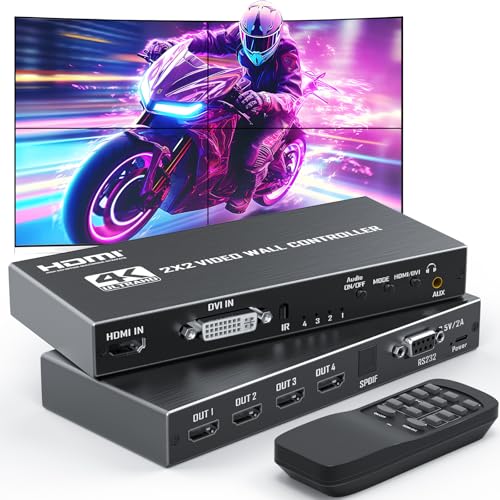
Jrepylxion’s 2×2 system offers multiple splicing modes, 180° rotation, and 1080P output compatibility, with separate audio ports for external amplification. It’s designed to divide a single source into four screens while maintaining synchronization across displays, making it suitable for trade shows, classrooms, and small-scale control centers where reliable multi-display output is essential.
Buying Guide: Key Considerations for 2×2 Video Wall Processors
- Display Modes and Layouts: Look for devices that support a wide range of layouts (2×2, 1×2, 1×3, 1×4, 2×1, 3×1, 4×1) and a dedicated Splitter/Splice mode for uniform content across all displays.
- Resolution and Refresh: Confirm the input and output resolutions and refresh rates. Many units support 4K input with 1080p or 4K output depending on the model; verify compatibility with your monitors and content.
- Rotation and Bezel Handling: Rotation (180°) helps in portrait installations and edge masking reduces seams. Consider how the controller manages bezels and whether edge masking is automatic or adjustable.
- Audio Routing: If audio is needed, check whether the device offers HDMI audio, SPDIF optical, and 3.5 mm outputs, and whether it can route to external audio systems or soundbars.
- Control and Connectivity: RS-232 and LAN control options enable remote management. IR remotes are convenient on-site; PC control can simplify integration into AV systems.
- Bezel and Warping Management: Some models offer EDID management and bezel adjustments to improve image alignment and reduce distortion at the seams.
- Compatibility: Ensure the device supports your source types (HDMI, USB-C) and your display panels (HDMI, DVI) without compatibility issues.
- Audio-Video Sync: Look for low-latency switching and reliable AV sync to keep content aligned across all screens, especially for live presentations.
- Mounting and Footprint: Consider the physical footprint, power requirements, and whether the unit can be placed on a shelf or rack alongside other AV equipment.
These considerations help in selecting a 2×2 video wall processor that aligns with content type, installation environment, and existing display hardware. When evaluating options, compare the maximum input resolution, supported modes, rotation capabilities, and audio routing options to ensure consistent performance across all four displays.