Choosing a reliable 24V charge controller is essential for protecting your battery bank and maximizing solar harvest in RVs, boats, and off-grid setups. This guide highlights five top options and explains how PWM and MPPT designs suit different systems, loads, and climates. Each product below is selected for compatibility with 24V configurations, battery types, and rugged environments. Use the Buying Guide to compare features, protections, and installation considerations before you buy.
| Product | Brand | Charging Type | Key Benefit |
|---|---|---|---|
| Renogy Wanderer 10A | Renogy | PWM | Simple, reliable 12V/24V operation with 4-stage charging |
| Renogy Adventurer 30A | Renogy | PWM | Advanced 4-stage charging with lithium compatibility |
| Renogy Voyager 20A | Renogy | PWM | Waterproof, rugged for outdoor use |
| Renogy Rover 40A | Renogy | MPPT | Fast MPPT tracking for higher efficiency |
| POWLAND 120A MPPT | POWLAND | MPPT | Auto-sensing across multiple voltages with high input |
Renogy Wanderer 10A PWM 12V/24V Solar Charge Controller
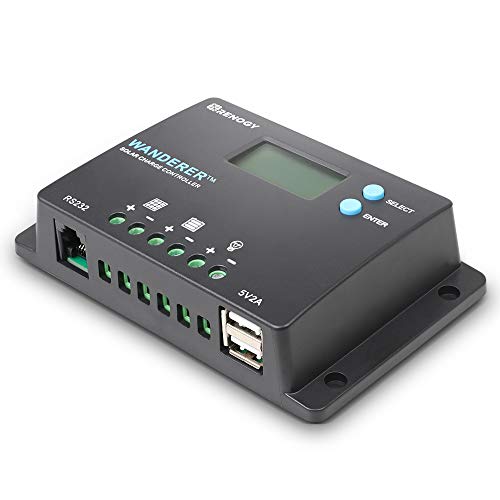
The Renogy Wanderer 10A is a compact PWM solar charge controller designed for 12V and 24V systems. It prioritizes battery protection with a four-stage charging process (Bulk, Boost, Float, Equalization) suitable for AGM, Gel, Flooded, and Lithium batteries. Its negative ground design supports safe installation in RVs and marine environments. The unit emphasizes low idle power and straightforward configuration, making it a practical option for smaller off-grid setups or auxiliary power in vehicles. Its LCD provides accessible status readouts for ongoing monitoring.
Key considerations
- Best for small arrays and modest battery banks
- PWM efficiency is adequate for limited solar input
- Negative-ground compatibility aids simple RV installations
Renogy Adventurer 30A PWM Solar Charge Controller

The Renogy Adventurer 30A PWM controller handles 12V/24V systems and supports AGM, Gel, Flooded, and Lithium batteries. Its four-stage charging (Bulk/Boost/Float/Equalization) enhances battery life, and the device can recondition weak lithium cells through specialized charging cycles. Negative-ground design supports safe integration in RV and marine systems, while a flush-mount design helps with tidy installations in controlled spaces. Real-time data can be tracked via optional accessories or Renogy’s app ecosystem.
Key considerations
- Suitable for moderate solar arrays and larger battery banks
- Negative-ground compatibility reduces risk of incorrect wiring
- Flush-mount option supports neater indoor installations
Renogy Voyager 20A PWM Waterproof Solar Charge Controller

The Renogy Voyager 20A PWM controller emphasizes durability with IP67 waterproof protection, making it suitable for outdoor RV, marine, and trailer use. It supports 12V/24V systems and various battery chemistries (AGM, Gel, Flooded, Lithium). The 4-stage charging process extends battery life, and the device incorporates multiple protections such as reverse polarity, overcharge, short-circuit, and temperature compensation to safeguard the system. The Voyager family focuses on robust outdoor performance without complex configuration.
Key considerations
- IP67 rating provides water resistance in exposed locations
- Ideal for outdoor solar installations and marine environments
- Basic LCD readouts aid quick system checks
Renogy Rover 40A MPPT Solar Charge Controller

The Renogy Rover 40A is a high-capacity MPPT controller designed for 12V/24V systems and compatibility with gel, sealed, flooded, and lithium batteries. With a dual-peak MPPT design, it optimizes panel input even in shading or variable conditions, delivering higher efficiency than PWM counterparts. The controller supports four-stage charging (Bulk, Absorption, Float, Equalization) and includes protections for reverse polarity, overload, short circuit, and thermal variations. It is suitable for larger off-grid or RV solar installations needing robust power management.
Key considerations
- Higher efficiency for larger arrays and faster battery charging
- Broad battery compatibility, including lithium
- Appropriate for rooftop or cabinet installations where space permits
Renogy Rover Lite 60A MPPT Solar Charge Controller

The Rover Lite 60A MPPT controller provides substantial charging capacity with MPPT efficiency designed for 12V to 48V systems. It supports lithium, AGM, Gel, and flooded batteries and handles up to six 200W panels in series when configured for higher voltages. It includes protection features like reverse polarity, overload protection, and open-circuit safeguards. Its broad voltage compatibility and high current make it well-suited for larger off-grid builds, RVs, and boats requiring steady power from sizeable solar arrays.
Key considerations
- High current handling supports larger solar arrays
- Wide voltage compatibility from 12V to 48V
- MPPT efficiency helps maximize energy harvest in variable conditions
Buying Guide: Choosing The Right 24V Charge Controller
When selecting a 24V charge controller, consider your system type, battery chemistry, and climate. PWM controllers are simple and reliable for small to medium setups, offering adequate performance at a lower cost but limited in high-irradiance scenarios. MPPT controllers extract more energy from panels, especially under high voltage and partial shading, but at a higher price and complexity. Match the controller to your battery bank size, solar array, and the presence of future expansion.
Key factors to compare:
- Voltage and system compatibility: Ensure 24V operation and battery chemistries you use (AGM, Gel, Flooded, Lithium).
- Charging algorithm and stages: Four-stage charging (Bulk, Absorption, Float, Equalization) is common; lithium-friendly stages can extend lifespan.
- Protection features: Look for reverse polarity, overcharge, short-circuit, overload, and temperature compensation.
- Environmental protection: IP ratings or weatherproofing if the controller sits outdoors or in wet environments.
- Efficiency and tracking: MPPT models offer higher efficiency, especially in hot climates or with higher panel voltages.
- Physical footprint and mounting options: Flush or surface mount, cabinet space, and airflow for heat management.
- Expandability: Ability to support more panels or higher system voltages in the future.
Installation considerations:
- Wire sizing and distance: Use appropriately rated cables to minimize losses between panels, controller, and battery bank.
- Grounding and safety: Follow manufacturer guidelines for grounding and avoid short circuits in RV or marine environments.
- Monitoring: Use built-in LCDs or companion apps to monitor voltage, current, and state of charge for proactive maintenance.
To maximize durability, plan for cold-weather operation if you’re in frigid environments, since some controllers exhibit performance shifts at extreme temperatures. For RVs and boats, consider units with corrosion and water resistance to endure exposure to humidity, salt spray, and frequent vibration. Finally, verify compatibility with any existing solar panels, battery management systems, and inverters to ensure harmonious operation across the system.