When building or upgrading a sound system, a high-quality 2-way passive crossover ensures smooth frequency separation between midrange/two-way speakers and tweeters. This guide highlights top options that balance power handling, component quality, and ease of installation. Each product is evaluated for suitability in car audio and Hi-Fi setups, and a practical buying guide follows to help you compare features, components, and performance without breaking the bank.
Summary of selected products:
| Product | Brand | Impedance | Audio Applications | Key Feature |
|---|---|---|---|---|
| DS18 PRO-CFX 2-Way Car Audio Passive Crossover | DS18 | 4-Ohm to 8-Ohm | Car Audio, Tweeters & Midrange | Professional-grade precision |
| 300 Watts 2 Way Crossover (2 Pack) CRX-203 | Audiopipe | 4-8 Ohm | Car Audio | Gold terminals, high power handling |
| 3 Way PUV-W3 200W Passive Crossover (2 Pack) | HiQltyla | 4-8 Ohm | Hi-Fi/Home Audio | High-quality components |
| 2 Pack 4 Ohm 3 Way Passive Crossover CRX-303 | Audiopipe | 4 Ohm | Car Audio | High power, multiple capacitors</ |
| 2 Way Passive Crossover with High Power (Dpofirs) | Dpofirs | Various (4-8 Ohm common) | Professional AV | High current, robust heat dissipation |
DS18 PRO-CFX 2-Way Car Audio Passive Crossover

The DS18 PRO-CFX Crossovers are designed to shape two speaker outputs with precision. They filter specific frequency bands to keep tweeters and midrange drivers from stepping on each other’s territory, delivering a controlled soundstage. With a declared 300W RMS capacity, these crossovers support robust loudness while preserving clarity. The unit emphasizes efficient frequency division and reliable performance, which is essential for enthusiasts chasing a clean upper register and strong midrange presence.
300 Watts 2 Way Crossover (2 Pack) CRX-203

These Audiopipe crossovers provide a straightforward solution for two-way systems in cars. They offer gold-plated screw terminals for reliable connections and a rated 150 Watts RMS / 300 Watts peak, suitable for moderate to high-power installations. The crossover frequency range covers typical tweeter and midrange separation, ensuring a balanced high end with controlled bass response. The build emphasizes sturdy terminals and robust construction, making installation straightforward for DIY projects.
3 Way PUV-W3 200W Passive Crossover (HiQltyla) 2Pack

HiQltyla’s 3-way crossovers provide additional branching for bass, midrange, and treble. With 200 watts peak capacity and impedance compatibility for 4-8 ohms, these units are designed for bookshelf and compact Hi-Fi setups. Features include screw-terminal installation for quick wiring and a focus on reliable components—bass inductors and MPX/MKP capacitors—that help improve overall sound quality. The specified frequency points suggest a smooth crossover across a broad spectrum, which is helpful for detailed treble and balanced mids.
2 Pack 4 Ohm 3 Way Passive Crossover CRX-303

CRX-303 crossovers extend the 3-way approach with 4-ohm impedance and a 300 watt total handling across two packs. The design includes high-grade polymer capacitors and advanced ferrite and air-cooled spools to support greater power handling while maintaining stability. Suitable for multi-driver installations, including midrange, woofer, and tweeter configurations, these units aim to deliver more precise highs and a stronger midrange when paired with compatible drivers.
2 Way Passive Crossover by Dpofirs
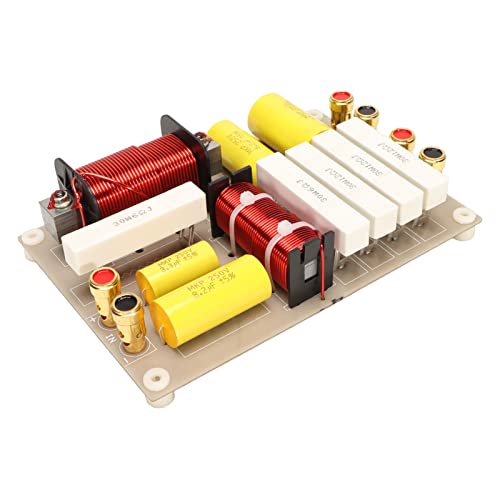
This 2-way crossover from Dpofirs emphasizes high-power handling and practical use for pro-level setups. The product description highlights practical sound improvements by separating frequency bands, enabling more accurate amplification for each driver. Built with large capacitors and high-power inductors, it is designed to improve heat dissipation and ensure long service life, making it suitable for extended listening sessions in professional AV or large room setups. A treble-preserving feature helps maintain clarity across long-term use.
300 Watts 2 Way Crossover for Car Audio Universal Heat Dissipation

Fydun’s 2-way crossover focuses on sound accuracy and bass response enhancement. It highlights a bass inductor and magnet to address bass sag, while a solderless plug-in system provides easy connections. The housing uses heat-dissipating ABS plastic with a high-gloss finish to boost durability and reduce heat-related aging. This option targets users seeking straightforward installation with dependable performance across standard car audio configurations.
Buying Guide: Key Purchase Considerations
Power handling and impedance are central to compatibility. Match crossover power ratings to your amplifier and speaker ratings, aiming for a comfortable safety margin to avoid distortion or component stress. Impedance should align with your speaker pairings (commonly 4-8 ohms for car and home speakers).
Filter slopes and crossover points influence the transition between drivers. Lower crossover points can improve integration with smaller tweeters, but may demand higher-quality drivers. Higher-quality components (capacitors, inductors) reduce signal loss and heat buildup, supporting cleaner mids and clearer highs over time.
Terminal design and wiring ease affect installation time and reliability. Gold-plated or corrosion-resistant terminals provide durable connections in automotive environments. Screw terminals are often easier for DIY installations compared with soldered junctions, but ensure solid mechanical contact for long-term performance.
Physical durability matters for mobile use. Look for robust housings and materials that dissipate heat effectively, especially in hot climates or in vehicles with limited airflow. If the product includes a two-way or three-way layout, verify the recommended speaker configuration to avoid mis-matched efficiency or phase issues.
Layout and mounting options matter for space-constrained installations like compact cars or tight hi-fi shelves. Some crossovers come with compact enclosures or flat profiles designed to fit behind dashboards or inside speaker enclosures. In professional AV contexts, seek crossovers with higher power handling, better heat management, and wider impedance tolerance to support a range of drivers.
Summary: When choosing a 2-way crossover, prioritize compatibility with your existing drivers, verify the frequency separation points align with your speaker’s response, and consider how the unit will handle heat under typical operating conditions. A well-chosen crossover improves coherence between drivers, enhances imaging, and preserves tonal balance across the listening spectrum.