The best 2-gig WiFi router depends on whether you prioritize WiFi 7, mesh-style coverage, or extra wireless bands. The Amazon eero Pro 6E is listed for internet plans up to 2.5 Gbps; the TP-Link BE6500 is best for WiFi 7 features and broad stated coverage; and NETGEAR’s tri-band WiFi 7 model is better suited to homes with demanding wireless activity. A router’s advertised WiFi speed is not the same as its wired internet-port capacity, so confirm port specifications before buying for a 2-gig plan.
| Router | Best For | Key Listed Detail |
|---|---|---|
| TP-Link BE6500 BE400 | WiFi 7 and coverage | Up to 2,400 sq. ft.; six streams |
| Amazon eero Pro 6E | Plans up to 2.5 Gbps | Up to 2,000 sq. ft.; 100+ devices |
| NETGEAR Nighthawk RS90 | WiFi 7 basics | 3.6 Gbps; up to 2,000 sq. ft. |
| NETGEAR Nighthawk Tri-Band WiFi 7 | Busy, demanding households | Tri-band WiFi 7; up to 2,500 sq. ft. |
| TP-Link AXE5400 WiFi 6E | Access to the 6 GHz band | Tri-band WiFi up to 5,400 Mbps |
TP-Link BE6500 BE400 WiFi 7 Router
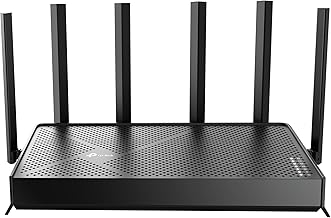
Best for: Households seeking WiFi 7 features and stated coverage for multiple users. TP-Link lists up to 6.5 Gbps of total dual-band bandwidth, with up to 5,764 Mbps on 5 GHz and 688 Mbps on 2.4 GHz. Those figures describe wireless band rates, not guaranteed internet speeds for one device.
The six-stream router includes Multi-Link Operation, Multi-RUs, 4K-QAM, six antennas, and Beamforming. Its listed maximum coverage is 2,400 square feet for up to 90 devices. These features make it a strong fit for a home with compatible newer devices and simultaneous streaming, work, or gaming use.
Limitation: It is dual-band, and the listed features do not state a 2-gigabit WAN port capacity. Confirm the wired port specifications if full 2-gig service over Ethernet is important.
Amazon eero Pro 6E Mesh Router

Best for: Buyers who want a router explicitly listed to support internet plans up to 2.5 Gbps. This one-pack eero Pro 6E is listed with coverage up to 2,000 square feet and support for more than 100 devices, making it a relevant option for a busy home on a multi-gig plan.
Limitation: The supplied product information does not state its WiFi band rates or Ethernet port details. Check the port specifications if you need to verify wired 2-gig throughput; the stated plan support alone does not guarantee a particular speed on every connection.
NETGEAR Nighthawk RS90 WiFi 7

Best for: Buyers looking for a straightforward WiFi 7 router with a stated 3.6 Gbps wireless rate and coverage up to 2,000 square feet. It is a compact comparison option for homes that want the newer WiFi generation without selecting a model based on a higher advertised wireless rate.
Limitation: The supplied details do not specify the wired port capacity or number of supported devices. Verify those details before choosing it for a 2-gig plan or a particularly crowded network.
NETGEAR Nighthawk Tri-Band WiFi 7 Router

Best for: Households with demanding simultaneous wireless use. NETGEAR describes this as a dedicated tri-band WiFi 7 router with a third high-speed band and coverage up to 2,500 square feet. It connects to an existing modem or gateway by Ethernet and is listed as compatible with most cable, fiber, DSL, and satellite providers.
The Nighthawk app provides guided setup and options to manage WiFi, run speed tests, pause devices, and create guest networks. Active internet is required for app use. A gateway or modem-router combination may need bridge mode.
Limitation: The supplied details do not give the router’s aggregate speed or exact port capacity. Check those specifications to determine whether it meets a specific wired 2-gig requirement.
TP-Link AXE5400 Tri-Band WiFi 6E Router

Best for: Buyers who want tri-band WiFi 6E and a dedicated 6 GHz band. Its listed total WiFi rate is up to 5,400 Mbps, divided among 6 GHz at 2,402 Mbps, 5 GHz at 2,402 Mbps, and 2.4 GHz at 574 Mbps. TP-Link also lists OFDMA and increased device capacity for simultaneous transmission.
The extra band may suit users who want to distribute wireless activity across three bands. The advertised total remains a wireless-rate figure, not a promise that one device will reach that speed.
Limitation: This is WiFi 6E, not WiFi 7, and the supplied details do not identify its WAN port capacity. Confirm wired specifications before buying for full-speed 2-gig service.
Buying Guide: How To Choose A 2-Gig Router
Does the router support a 2-gig internet plan?
Look for explicit plan support or a WAN port specification that meets your service speed. A router’s combined WiFi rate can exceed 2 Gbps while its internet-facing Ethernet port may be a separate constraint. The eero listing explicitly states support for plans up to 2.5 Gbps; for the other models here, check the manufacturer’s port details.
Should you choose WiFi 7, WiFi 6E, or a mesh-style model?
WiFi 7 models add features such as Multi-Link Operation on the TP-Link BE6500. WiFi 6E models, such as the TP-Link AXE5400, provide a 6 GHz band. Choose according to the devices in your home and the features you need. The eero Pro 6E listing describes a one-pack mesh router; its key advantage in the supplied details is support for plans up to 2.5 Gbps and 100+ devices.
How much coverage and device capacity do you need?
Compare stated coverage and device counts against your home layout and number of connected devices. Listed coverage is a maximum, not a guarantee for every building. Walls, router placement, and interference can affect real-world WiFi range and speed.
Frequently Asked Questions
What does a 2-gig WiFi router mean?
It generally refers to a router intended for a 2-gigabit-per-second internet plan. Confirm the WAN port and service compatibility; WiFi headline rates do not guarantee 2 Gbps to one device.
Can WiFi deliver the full speed of a 2-gig plan?
It may, under suitable conditions, but wireless performance varies with device capability, distance, interference, and network load. Wired results also depend on the router’s port capacity.
Is the router’s advertised total WiFi speed the same as internet speed?
No. Total WiFi rates describe theoretical combined wireless bandwidth across bands. A single device typically uses a portion of that capacity.
Which listed router explicitly supports plans faster than 2 Gbps?
The Amazon eero Pro 6E listing says it supports internet plans up to 2.5 Gbps. Check its port specifications and your service setup when evaluating wired performance.
Should I prioritize coverage or WiFi generation?
Prioritize coverage if you need signal across a larger home; prioritize WiFi generation and band features if your devices support them and you want newer wireless capabilities. Compare both alongside wired port capacity.