The best 2.4GHz antenna for long-range WiFi depends on whether you need to cover an area around the antenna or aim a signal toward a distant location. The Kaunosta 25dBi Yagi is best for a focused, aimed connection; its 22dBi omni model is designed for broader coverage. For dual-band setups, consider Eifagur’s 15dBi panel or 10dBi fiberglass antenna. Check your device’s connector and supported frequency before choosing.
| Product | Best For | Design | Frequency |
|---|---|---|---|
| Kaunosta 25dBi Yagi | Aimed 2.4GHz links | Directional | 2.4GHz |
| Kaunosta 22dBi antenna | Outbuildings and open areas | Omnidirectional | 2.4GHz |
| Eifagur 15dBi panel | Dual-band targeted coverage | Directional | 2.4GHz and 5GHz |
| Eifagur 10dBi fiberglass | Outdoor dual-band setups | Directional | 2.4GHz and 5GHz |
| Eifagur 9dBi antenna | General dual-band upgrades | Not specified | 2.4GHz and 5GHz |
Kaunosta 25dBi Yagi Antenna

This Kaunosta antenna is a highly directional Yagi designed for 2.4GHz, with a stated maximum gain of 25dBi. It has an RP-SMA connector, a 1.5-meter cable, and a 50-centimeter antenna. Its aluminum-alloy construction and waterproof design are listed features.
Best for: A point-to-point connection where you can aim the antenna toward the signal source. Choose this if a focused link matters more than coverage in every direction. Its 2.4GHz-only frequency range means it is not the choice for a 5GHz connection. Directional placement is essential; it must be aimed toward the other device.
Kaunosta 22dBi Omni Antenna

Designed for 2.4GHz, this high-gain omnidirectional antenna includes a 10-foot RG174 extension cable and an RP-SMA male connector. The manufacturer describes it as suitable for point-to-point connections to places such as detached garages, barns, sheds, and garden cameras, and claims up to 250 feet in open areas.
Best for: Buyers who want an omnidirectional design and more flexible antenna placement. The extension cable can help position the antenna higher or outdoors. The stated range is for open areas, so obstacles and the receiving device can affect results. It supports 2.4GHz, not the 5GHz band.
Eifagur 15dBi Dual-Band Panel Antenna
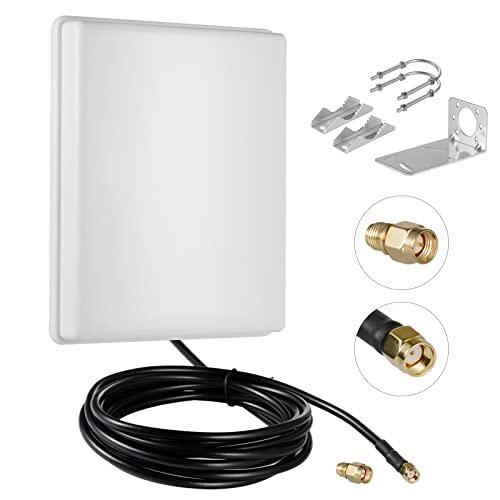
This outdoor panel antenna lists 15dBi gain, directional operation, an RP-SMA male connector, and a 10-foot RG58 cable. It supports 2.4GHz and 5GHz/5.8GHz and is described as waterproof. Listed device types include routers, repeaters, security cameras, wireless access points, and PCI WiFi adapters.
Best for: Users who need a directional antenna that supports both common WiFi bands. It is a better fit than an omnidirectional model when the target area is in a specific direction. Because it is directional, placement and aiming matter. Confirm that the device has a matching RP-SMA connection before purchasing.
Eifagur 10dBi Fiberglass Antenna

This 10dBi fiberglass antenna supports 2.4GHz and 5GHz/5.8GHz, with a 10-foot cable and RP-SMA male connector. Its listed features include outdoor waterproofing and all-weather operation. The product information describes its direction as directional, so it should not be treated as an omnidirectional replacement.
Best for: Buyers seeking an outdoor dual-band option with a long cable for placement flexibility. It is listed for routers, repeaters, security cameras, and network cards. Check the connector type and device frequency support first. The directional design may not suit a setup that needs equal coverage all around the antenna.
Eifagur 9dBi Dual-Band Antenna

This Eifagur antenna is listed as a 9dBi model supporting 2.4GHz and 5GHz/5.8GHz. The product description names routers, access points, security IP cameras, and RV cameras among compatible device types. It does not provide connector, cable, or antenna-direction details in the supplied specifications.
Best for: Buyers looking for a dual-band antenna for a listed device type who can verify the connection details before ordering. It may be a simpler option than products with clearly stated cable and connector specifications, but those missing details are an important limitation. Confirm the connector and mounting requirements with the seller or product listing.
Buying Guide: How To Choose A Long-Range 2.4GHz Antenna
Should you choose directional or omnidirectional?
A directional antenna concentrates coverage toward a particular direction, making it a practical option for a distant building or a fixed camera. It must be aimed correctly. An omnidirectional antenna is designed to send or receive signals around the antenna, which can suit devices spread across an open area. The antenna’s design matters as much as its stated gain.
Does the antenna need to support 5GHz?
Choose a 2.4GHz-only model if the device and link use that band. If you want to retain access to 5GHz or 5.8GHz, select an antenna whose listed frequency range includes those bands. A dual-band antenna cannot make a device support a frequency it does not already use.
What connector and cable should you check?
Match the antenna connector to the device’s antenna port; RP-SMA male is listed for several products here, but connector types are not universal. Check cable length and type as well. A longer cable can make placement easier, but the supplied product information does not establish that every cable suits every device or installation.
How should you compare gain claims?
Use the listed dBi figure as one comparison point, not a guarantee of a particular indoor or outdoor range. Walls, obstructions, antenna orientation, and the connected device can all affect the actual link. Manufacturer range claims, such as the 22dBi model’s open-area estimate, should be read in the conditions stated.
Frequently Asked Questions
Will a higher-gain antenna always provide longer range?
No. Gain is only one factor. Direction, placement, obstacles, device compatibility, and the receiving antenna also influence coverage.
Can I use a 2.4GHz antenna with a 5GHz device?
Only if the antenna’s listed frequency range supports 5GHz. The Kaunosta Yagi listed here is 2.4GHz-only; the Eifagur dual-band models list 5GHz support.
Is a directional antenna better for a detached garage?
It can be suitable when the garage is in a specific direction and the antenna can be aimed toward it. An omnidirectional model may suit a broader coverage pattern.
Does a longer antenna cable improve WiFi range?
Not necessarily. A longer cable offers more placement flexibility, but the supplied specifications do not guarantee a range improvement from cable length alone.
What should I verify before buying?
Check supported frequency, connector type, antenna direction, cable length, and whether the device allows an external antenna. These details help prevent a mismatch.